


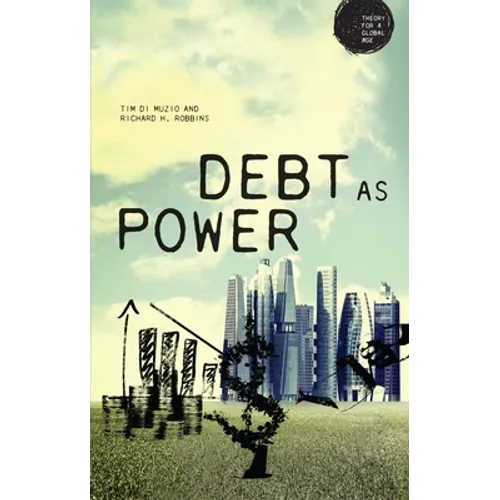
Product Description
by Richard H. Robbins (Author), Tim Di Muzio (Author)
Debt as Power is a timely and innovative contribution to our understanding of one of the most prescient issues of our time: the explosion of debt across the global economy and related requirement of political leaders to pursue exponential growth to meet the demands of creditors and investors. The book is distinctive in offering a historically sensitive and comprehensive analysis of debt as an interconnected and global phenomenon.
Front Jacket
Debt as power is a timely and innovative contribution to our understanding of one of the most prescient issues of our time: the explosion of debt across the global economy and related requirement of political leaders to pursue exponential growth to meet the demands of creditors and investors. The book is distinctive in offering a historically sensitive and comprehensive analysis of debt as an interconnected and global phenomenon. Rather than focusing on the historical emergence of debt as a moral obligation, the authors argue that debt under capitalism can be conceived of as a technology of power, intimately tied up with the requirement for perpetual growth and the differential capitalization that benefits 'the 1%'. Their account begins with the recognition that the histories of human communities and their natural environment are interconnected in complex spatial and hierarchical relations of power and to understand their development we need to not only examine the particularities of a given case, but more importantly their interconnected, interdependent and international relations. Since debt under capitalism is increasingly ubiquitous at all levels of society and economic growth is now the sole mantra of dominant political parties around the world, the authors argue that tracing the evolution and transformation of debt as a technology of power is crucial for understanding the 'present as history' and possible alternatives to our current trajectory.
Back Jacket
Debt as power is a timely and innovative contribution to our understanding of one of the most prescient issues of our time: the explosion of debt across the global economy and related requirement of political leaders to pursue exponential growth to meet the demands of creditors and investors.
The book is distinctive in offering a historically sensitive and comprehensive analysis of debt as an interconnected and global phenomenon. Rather than focusing on the historical emergence of debt as a moral obligation, the authors argue that debt under capitalism can be conceived of as a technology of power, intimately tied up with the requirement for perpetual growth and the differential capitalization that benefits 'the 1%'. Their account begins with the recognition that the histories of human communities and their natural environment are interconnected in complex spatial and hierarchical relations of power and to understand their development we need to not only examine the particularities of a given case, but more importantly their interconnected, interdependent and international relations. Since debt under capitalism is increasingly ubiquitous at all levels of society and economic growth is now the sole mantra of dominant political parties around the world, the authors argue that tracing the evolution and transformation of debt as a technology of power is crucial for understanding the 'present as history' and possible alternatives to our current trajectory.Author Biography
Richard H. Robbins is Distinguished Teaching Professor in Anthropology at Plattsburg State University of New York, USA