


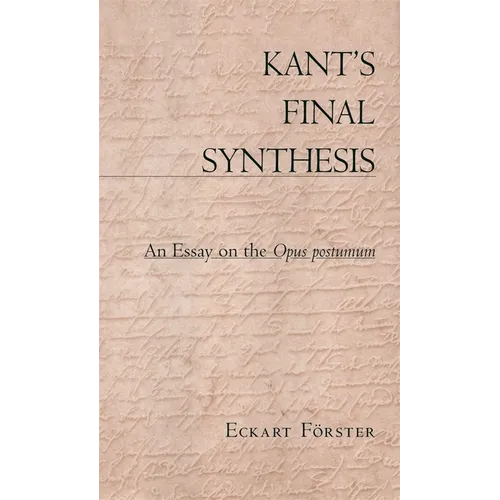
PRODUCT DESCRIPTION
by Eckart Förster (Author)
This is the first book in English devoted entirely to Kant's Opus postumum and its place in the Kantian oeuvre. Over the last few decades, the importance of this text for our understanding of Kant's philosophy has emerged with increasing clarity.
Although Kant began it in order to solve a relatively minor problem within his philosophy, his reflections soon forced him to readdress virtually all the key problems of his critical philosophy: the objective validity of the categories, the dynamical theory of matter, the natures of space and time, the refutation of idealism, the theory of the self and its agency, the question of living organisms, the doctrine of the practical postulates and the idea of God, the unity of theoretical and practical reason, and the idea of transcendental philosophy itself. In the end Kant was convinced that these problems, some of which had preoccupied him throughout his career, could finally be brought to a coherent and adequate solution and integrated into a single philosophical conception. As Eckart Förster shows in his penetrating study, Kant's conviction deserves not only our intellectual respect but also our undivided philosophical attention. Förster provides detailed analyses of the key problems of Kant's Opus postumum and also relates them to Kant's major published writings. In this way he provides unique insights into the extraordinary continuity and inner dynamics of Kant's transcendental philosophy as it progresses toward its final synthesis.
Number of Pages: 230
Dimensions: 0.8 x 8.5 x 5.4 IN
Publication Date: September 15, 2002


