


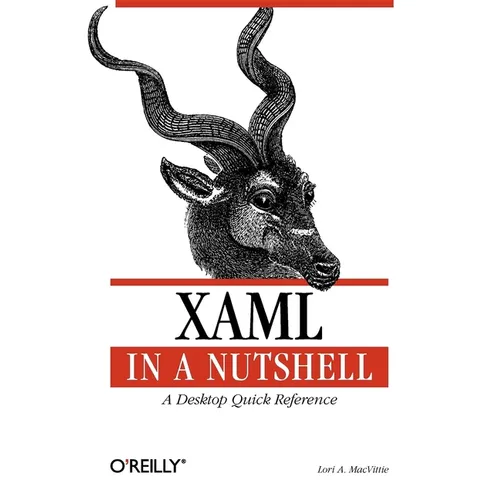
Product Description
by Lori A. Macvittie (Author)
When Microsoft releases Windows Vista, the new operating system will support applications that employ graphics now used by computer games--clear, stunning, and active. The cornerstone for building these new user interfaces is XAML ("Zammel"), the XML-based markup language that works with Windows Presentation Foundation (WPF), Vista's new graphics subsystem.
An acronym for Extensible Application Markup Language, XAML offers a wealth of new controls and elements with exciting capabilities, including animation and rendering of 3D graphics. Windows developers are already jazzed by the possibilities of using XAML for fixed and flow format documents like PDF and HTML, 2D and 3D vector-based graphics, form development, animation, audio and video, transparent layering, and a lot more. Many feel that XAML will eliminate the need for multiple file formats or plug-ins (read: Flash), while lowering development costs and reducing time to market.
The problem is, most developers don't know XAML. While it is fairly easy to understand, you still need a quick guide to bring you up to speed before Vista's release, and that's where this book's simple, no nonsense approach comes in.
XAML in a Nutshell covers everything necessary to design user interfaces and .NET applications that take advantage of WPF. Prerequisites such as Microsoft's new unified build system, MSBuild, and core XAML constructs and syntax--including shortcuts--are all presented with plenty of examples to get you started. The Core XAML Reference section lets you dig even deeper into syntax rules and attributes for all XAML elements with a series of quick-reference chapters. This section divides XAML elements into logical categories of elements, controls, shapes and geometry, layout, animations, and transformations for easy reference.
XAML in a Nutshell helps you learn, firsthand, how to use this XML-based markup language to implement the new generation of user interface graphics. As one reviewer noted, "Strong code examples and an efficient, conversational style take the tedium out of learning XAML and make the subject understandable--even interesting."
Author Biography
Lori MacVittie is currently a Senior Technology Editor with Network Computing Magazine. In past lives she has been a software developer, a network administrator, and an enterprise architect specializing in web-based technologies. Through the course of her career she has nearly coded her way through the alphabet, starting with Apple BASIC, hitting "L" for LISP while consulting for Autodesk, and is currently on the letter "Y". Lori holds an M.S. in Computer Science from Nova Southeastern University, and lives with her husband and children in the technological mecca of the midwest, Green Bay, Wisconsin.