


Product Description
by Richard Garfinkle (Author), David Garfinkle (Author)
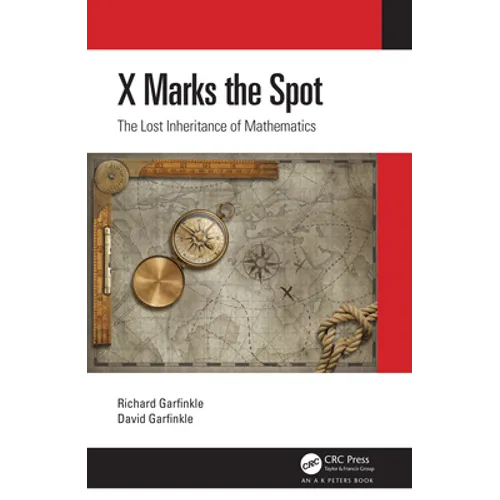
X Marks the Spot is written from the point of view of the users of mathematics. Since the beginning, mathematical concepts and techniques (such as arithmetic and geometry) were created as tools with a particular purpose like counting sheep and measuring land areas.
Understanding those purposes leads to a greater understanding of why mathematics developed as it did. Later mathematical concepts came from a process of abstracting and generalizing earlier mathematics. This process of abstraction is very powerful, but often comes at the price of intuition and understanding. This book strives to give a guided tour of the development of various branches of mathematics (and what they're used for) that will give the reader this intuitive understanding.
Features
- Treats mathematical techniques as tools, and areas of mathematics as the result of abstracting and generalizing earlier mathematical tools
- Written in a relaxed conversational and occasionally humorous style making it easy to follow even when discussing esoterica.
- Unravels how mathematicians think, demystifying math and connecting it to the ways non-mathematicians think and connecting math to people's lives
- Discusses how math education can be improved in order to prevent future generations from being turned off by math.
Author Biography
David Garfinkle was born in 1958 and wanted to be a physicist ever since his first year of high school. He got a bachelor's degree from Princeton University in 1980 and a PhD from The University of Chicago in 1985. Since 1991 he has been a physics professor at Oakland University in Michigan.
David is the author of over 100 articles in physics journals. His main areas of research are black holes, spacetime singularities, and gravitational radiation. He performs computer simulations of gravitational collapse to resolve questions about black holes and singularities.
David was named a Fellow of the American Physical Society (APS) with the citation reading "for his numerous contributions to a wide variety of topics in relativity and semiclassical gravity."
David and Richard have written Three Steps to the Universe (U. of Chicago Press, 2008) a book on black holes and dark matter.
For the better part of his early life, Richard Garfinkle thought he wanted to be a mathematician. He went so far as to spend four years studying math at the University of Chicago before discovering that he really wanted to be a writer. He has had several science fiction and fantasy novels published. His first Celestial Matters (Tor 1996) won the Compton Crook award for best first novel. Richard and David have written Three Steps to the Universe (U. of Chicago Press, 2008) a book on black holes and dark matter. For his day job, he programs computers. Richard lives in Chicago with his wife and children.