


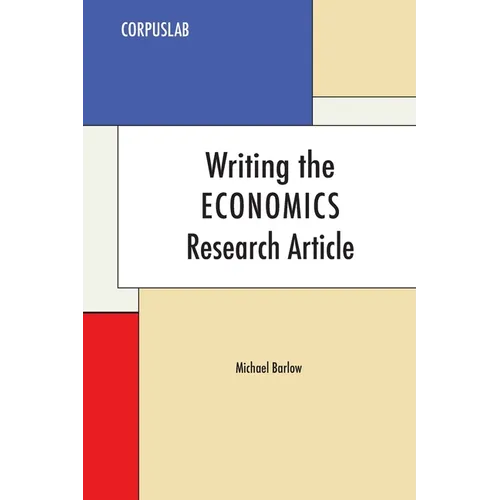
Product Description
by Michael Barlow (Author)
You've done the research. You have the results. Now you have to write the paper - and nobody taught you how.
Most economics undergraduate and graduater programs assume you'll absorb writing conventions by osmosis: read enough papers, attend enough seminars, and eventually you'll figure out how an Introduction works.
Writing the Economics Research Article makes the implicit conventions explicit. Drawing on a corpus of 149 published economics and econometrics articles (over 815,000 words spanning macro, labour, development, finance, health, trade, econometrics, and more), it reveals what published writers actually do, section by section, sentence by sentence.
The findings are specific and immediately actionable. For example, Economics Introductions account for roughly 38% of the paper, which is far more than in the sciences. 68% of papers preview their results in the Introduction. Conclusions average just 504 words. Research gaps are created primarily through adversative connectives like however, not through phrases like "little research has examined." Only 8% of papers follow a standard IMRDC structure; the rest use a mix of functional and thematic headings that reflects the discipline's distinctive approach to argument.
Thirteen units take you through every section of the paper: from architecture and framing (Introduction, Conclusion, Abstract) through the body sections (Model, Data, Estimation, Results) to the cross-paper features that reviewers notice even when you don't: hedging calibration, tense consistency, citation strategy, etc.
Every unit follows the same practical structure. First, a set of conceptualisation questions to answer before you write. Then, corpus frequencies showing what published writers do. Then, real example sentences from published articles. Not invented models, but actual language from peer-reviewed work. Finally, a revision checklist you can apply to your own draft.
This book won't tell you what to argue or how to do your econometrics. It will show you how to present your work in the form that reviewers and readers expect.
Written for students drafting their first paper, researchers entering economics from other disciplines, and non-native English speakers writing for economics journals. If you've ever stared at a blank screen wondering how your Introduction should begin, how much hedging is enough, or whether your Conclusion is too long - this book gives you the numbers.