Skip to content
Welcome To Our Store.
100,000+ Products for Home, Medical, Office & Classroom Needs
Search
Skip to product information
1 of 1

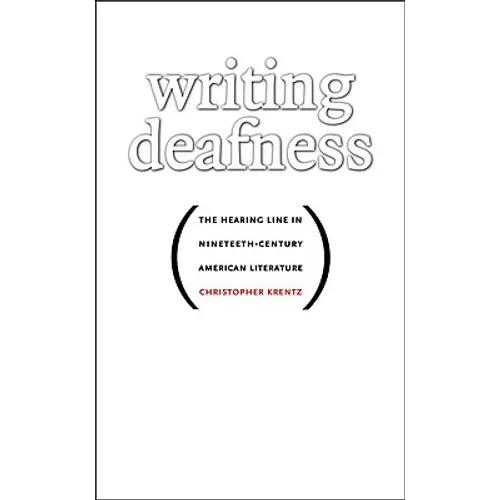
Writing Deafness: The Hearing Line in Nineteenth-Century American Literature - Paperback

$56.63 USD
$56.63 USD
Sale Sold out
Shipping calculated at checkout.
In stock (100 units), ready to be shipped

Available Offers

Fast delivery available on most orders

Multiple secure payment options accepted

Secure checkout with
  • American Express
  • Apple Pay
  • Diners Club
  • Discover
  • Google Pay
  • Mastercard
  • PayPal
  • Shop Pay
  • Visa

Flight Range: Up to 1,000 meters (3,280 feet)

Maximum Speed: 45 kilometers per hour (28 miles per hour)

For all orders exceeding a value of 100USD shipping is offered for free.

Returns will be accepted for up to 10 days of Customer’s receipt or tracking number on unworn items. You, as a Customer, are obliged to inform us via email before you return the item.

Otherwise, standard shipping charges apply. Check out our delivery Terms & Conditions for more details.

View Product Details
Shopping cart
Product Product subtotal Quantity Price Product subtotal
Writing Deafness: The Hearing Line in Nineteenth-Century American Literature - Paperback
$56.63/ea
$0.00
$56.63/ea $0.00

Product Description

by Christopher Krentz (Author)

Taking an original approach to American literature, Christopher Krentz examines nineteenth-century writing from a new angle: that of deafness, which he shows to have surprising importance in identity formation. The rise of deaf education during this period made deaf people much more visible in American society. Krentz demonstrates that deaf and hearing authors used writing to explore their similarities and differences, trying to work out the invisible boundary, analogous to Du Bois's color line, that Krentz calls the "hearing line."

Writing Deafness examines previously overlooked literature by deaf authors, who turned to writing to find a voice in public discourse and to demonstrate their intelligence and humanity to the majority. Hearing authors such as James Fenimore Cooper, Lydia Huntley Sigourney, Herman Melville, and Mark Twain often subtly took on deaf-related issues, using deafness to define not just deaf others, but also themselves (as competent and rational), helping form a self-consciously hearing identity. Offering insights for theories of identity, physical difference, minority writing, race, and postcolonialism, this compelling book makes essential reading for students of American literature and culture, deaf studies, and disability studies.


Number of Pages: 280
Dimensions: 0.7 x 8.33 x 5.56 IN
Publication Date: September 03, 2007
you might like
