


Product Description
by Kathryn Bernhardt (Author)
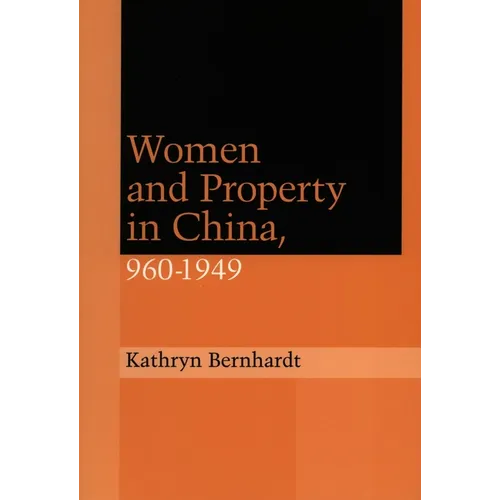
Drawing on newly available archival case records, this book demonstrates that Chinese women's rights to property changed substantially from the Song through the Qing dynasties, and even more dramatically under the Republican Civil Code of 1929-30.
Front Jacket
Previous scholarship has presented a static picture of property inheritance in China, mainly because it has focused primarily on men, whose rights changed little throughout the Imperial and Republican periods. However, when our focus shifts to women, a very different and dynamic picture emerges.
Drawing on newly available archival case records, this book demonstrates that women's rights to property changed substantially from the Song through the Qing dynasties, and even more dramatically under the Republican Civil Code of 1929-30. The consolidation in law of patrilineal succession in the Ming and Qing dynasties curtailed women's claims, but the adoption of the Civil Code and the gradual dismantling of patrilineal succession in the twentieth century greatly strengthened women's rights to inherit property.
Through an examination of the changes in women's claims, the author argues that we can discern larger changes in property rights in general. Previous scholarship assumed that patrilineal succession and household division were but different sides of the same coin--sons divided their father's property equally as his patrilineal heirs. The focus on women, however, reveals that patrilineal succession and household division were, in fact, two separate processual and conceptual complexes with their own distinct histories. While household division changed little, patrilineal succession changed greatly. Imperial and Republican laws of inheritance, finally, were based on two radically different property logics, the full implications of which cannot be truly appreciated unless the two are examined in tandem.
Back Jacket
This is an original and wholly new analysis of changes in women's inheritance rights in China. . . . With her mastery of the legal code and the language of casebooks, as well as her access to unique archival collections, Bernhardt's findings rest on an irreproachable mass of data; the book is a classic example of careful scholarship.--Susan Mann, University of California, Davis
"Using research from 430 actual cases during the period covered . . . Bernhardt emphasizes how the laws were applied in practice rather than what those laws actually mandated. . . . As such, the book is a valuable addition to scholarship on Chinese history, and more specifically the complex history of Chinese women."--History: Reviews of New Books
Author Biography
Kathryn Bernhardt is Professor of History at the University of California, Los Angeles.



