


Product Description
by Henri Lustiger Thaler (Editor), Habbo Knoch (Editor)
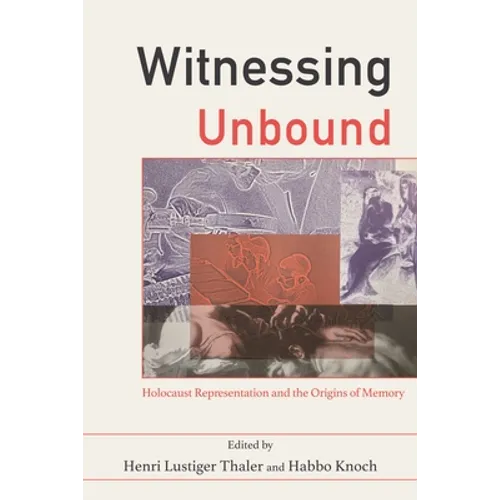
Primary witnessing, in its original forms-from survivor and bystander testimonies, to memoirs and diaries-inform our cultural understanding of the multiple experiences of the Holocaust. Henri Lustiger Thaler and Habbo Knoch look at many of these expressions of primary witnessing in Witnessing Unbound: Holocaust Representation and the Origins of Memory, which is particularly relevant today with the hastening decline of the Holocaust survivor demographic and the cultural spaces for representation it leaves in its wake, in addition to the inevitable and cyclical search for generational relevancy, siphoned through acts of memory.
The essays in Witnessing Unbound are written by some of the leading figures on the theme of witnessing as well as scholars exploring new primary sources of knowledge about the Holocaust and genocide. These include a focus on the victims: the perished and survivors whose discursive worlds are captured in testimonies, diaries, and memoirs; the witnessing of peasant bystanders to the terror; historical religious writing by rabbis during and after the war as a proto memoir for destroyed communities, and the archive as a solitary witness, a constructed memory in the aftermath of a genocide. The experiences showcased and analyzed within this memorializing focus introduce previously unknown voices, and end with reflections on the Belzec Memorial and Museum. One survivor moves hearts with the simple insight, "I died in Auschwitz, but no one knows [sees] it." In counterpoint is a court case with SS General Karl Wolff, who has conveniently forgotten his crimes during the Holocaust. Original experience and its reimagination within contemporary frameworks make sense of an event that continues to adapt and change metaphorically and globally. As one of the contributors writes: "In my mind, the 'era of the witness' begins when the historical narrative consists of first-person accounts."
Witnessing Unbound augers in the near completion of that defining era, by introducing a collection of diverse reflections and mediations on witnessing and memory. A must-read for the further understanding of the Holocaust, its cruel reality, and its afterdeath.
Author Biography
Henri Lustiger Thaler is a professor of cultural sociology at Ramapo College of New Jersey. He is the chief curator of the Amud Aish Memorial Museum in New York and series editor of Memory Studies: Global Constellations.
Habbo Knoch is a professor of Modern and Contemporary History at the University of Cologne, Germany. He is the former director of the Bergen-Belsen Memorial Museum. He is the co-editor of Bergen-Belsen.


