Product Description
by Charles River (Author)
*Includes pictures
*Includes online resources and a bibliography for further reading
When William Randolph Hearst was in his late 50s and at the height of his power, journalist Robert Duffuss observed, "His career is unique in American history, or, for that matter, all history. Compared with him the Bennetts and even the Pulitzers are small...his acquaintances...credit him with personal charm, but do not deny his ruthlessness in business operations. Shopkeepers and his nearest rivals are simply not in his class. Here is success on a dizzying and truly American scale. Here is journalism as large as the Rocky Mountains or the Painted Desert."
However, despite his massive success, and perhaps in large measure because of it, many of Heart's contemporaries depicted him in negative ways. As Duffuss also noted, when it came to the newspaper magnate's reputation, there was "a curious suggestion of lath and plaster about it, and far from being universally honored and admired as other self-made men have been, Mr. Hearst is regarded by multitudes of his fellow citizens with extreme aversion and distrust. Indeed, his career is almost never examined dispassionately and for this reason some of the salient facts about him are worth setting down in a somewhat cold-blooded manner."
It is only right to keep every positive and negative viewpoint in mind when looking at the life of a man who built his own fortune with money inherited from a father who literally grubbed it out of the ground with his own hands. While the senior Hearst may never have gotten the soil of old California from under his nails, William Randolph would never know what it felt like to live a life of manual labor; instead, he founded his empire on another kind of dirt, that which he was able to dig up and publish about the people, great and small, of his day. He would also stir up a good bit of dirt himself.
When it comes to Hollywood and the entertainment industry, perhaps nobody catapulted to fame as quickly or as strangely as Orson Welles, and it was due in large measure to the man who hated him more than anyone else in the world. Though Welles he had worked on stage productions from an early age and seamlessly transitioned into radio, few were familiar with his work until a legendary 1938 radio broadcast of H.G. Wells' The War of the Worlds, during which some people who heard Welles narrating the work truly believed that an alien invasion was underway. As Welles famously apologized at the end of the broadcast, "This is Orson Welles, ladies and gentlemen, out of character, to assure you that The War of the Worlds has no further significance than as the holiday offering it was intended to be; The Mercury Theatre's own radio version of dressing up in a sheet and jumping out of a bush and saying 'Boo '"
Although the alleged widespread hysteria caused by that broadcast is mostly overstated, the notorious broadcast made Welles a household name, and he only followed it up with one of the greatest movies ever made: Citizen Kane. As the co-writer, producer, director, and main star of the film, a biting social critique of William Randolph Hearst, Welles' first movie would end up being his most famous and critically acclaimed. Of course, it also ensured that he would continue to work across every entertainment medium for the next 4 decades, juggling radio, the stage, movies, and television throughout the rest of his illustrious career.
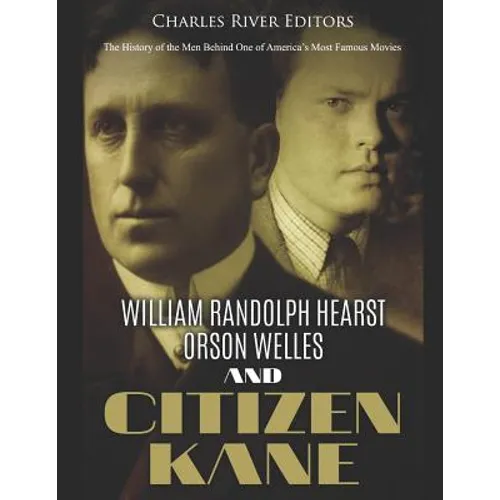
William Randolph Hearst, Orson Welles, and Citizen Kane: The History of the Men Behind One of America's Most Famous Movies examines the various roles Hearst played in American journalism and politics during his life, and how he "inspired" Welles to make one of America's most important films. Along with pictures depicting important people, places, and events, you will learn about the story of Hearst, Welles, and Citizen Kane like never before.