


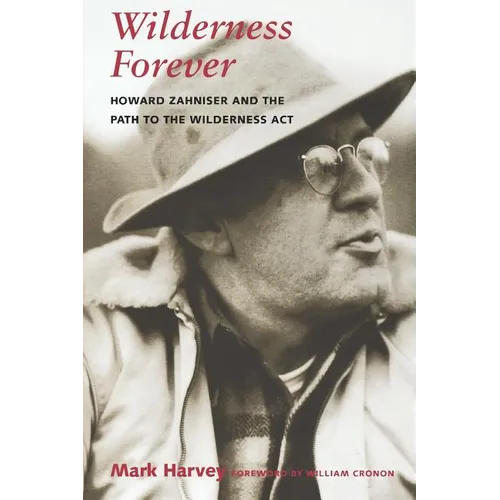
Product Description
by Mark W. T. Harvey (Author), William Cronon (Foreword by)
Winner of the Forest History Society's 2006 Charles A. Weyerhaeuser Book Award
As a central figure in the American wilderness preservation movement in the mid-twentieth century, Howard Zahniser (1906-1964) was the person most responsible for the landmark Wilderness Act of 1964. While the rugged outdoorsmen of the earlyenvironmental movement, such as John Muir and Bob Marshall, gave the cause a charismatic face, Zahniser strove to bring conservation's concerns into the public eye and the preservationists' plans to fruition. In many fights to save besieged wild lands, he pulled together fractious coalitions, built grassroots support networks, wooed skittish and truculent politicians, and generated streams of eloquent prose celebrating wilderness.
Zahniser worked for the Bureau of Biological Survey (a precursor to the Fish and Wildlife Service) and the Department of the Interior, wrote for Nature magazine, and eventually managed the Wilderness Society and edited its magazine, Living Wilderness. The culmination of his wilderness writing and political lobbying was the Wilderness Act of 1964. All of its drafts included his eloquent definition of wilderness, which still serves as a central tenet for the Wilderness Society: "an area where the earth and its community of life are untrammeled by man, where man himself is a visitor who does not remain." The bill was finally signed into law shortly after his death.
Pervading his tireless work was a deeply held belief in the healing powers of nature for a humanity ground down by the mechanized hustle-bustle of modern, urban life. Zahniser grew up in a family of Methodist ministers, and although he moved away from any specific denomination, a spiritual outlook informed his thinking about wilderness. His love of nature was not so much a result of scientific curiosity as a sense of wonder at its beauty and majesty, and a wish to exist in harmony with all other living things. In this deeply researched and affectionate portrait, Mark Harvey brings to life this great leader of environmental activism.
Front Jacket
As a central figure in the American wilderness preservation movement in the mid-twentieth century, Howard Zahniser (1906-1964) was the person most responsible for the landmark Wilderness Act of 1964, which included his eloquent definition of wilderness: Â"an area where the earth and its community of life are untrammeled by man, where man himself is a visitor who does not remain.Â" In this deeply researched and affectionate portrait, Mark Harvey brings to life this great leader of environmental activism.
Author Biography
Mark Harvey is professor of history at North Dakota State University in Fargo. He is the author of A Symbol of Wilderness: Echo Park and the American Conservation Movement.



