


Product Description
by Peter Zamarovsky (Author)
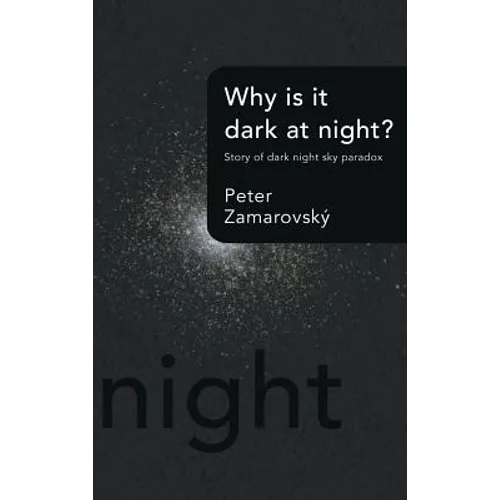
"Why is it dark at night?" might seem a fatuous question at first sight. In reality it is an extremely productive question that has been asked from the very beginning of the modern age, not only by astronomers, for whom it is most appropriate, but also by physicists, philosophers, and even poets. The book you have just opened uses this question as a pretext to relate in the most interesting way the history of human thought from the earliest times to the here and now. The point is that if we want to appreciate the magic power of this ostensibly naïve question we need to discover how it fits into the wider context of the natural sciences and learn something of the faltering steps towards an answer. In doing so the author guides us through periods that we regard as the dim and distant past. However, as we start reading these passages we are amazed to discover just how searching were the questions the ancient philosophers asked themselves in spite of their fragmentary knowledge of the universe, and how clairvoyantly they were able to gaze into its mysterious structure. The author goes on to explain very graphically how this increasingly prickly question was tackled by many great men of science. It is bound to come as a surprise that it was not a philosopher, a physicist or an astronomer, but instead the poet Edgar Alan Poe, who hinted at the right answer. I know of no other similar publication that has dealt so graphically or so succinctly with a question which, after four centuries of fumbling and chasing up blind alleys, was only solved in our lifetime. Jiří Grygar, president of Czech Learned Society, honorary Chairman of the Czech Astronomical Society



