Product Description
by Christopher Fry (Author), Lieberman Henry (Author)
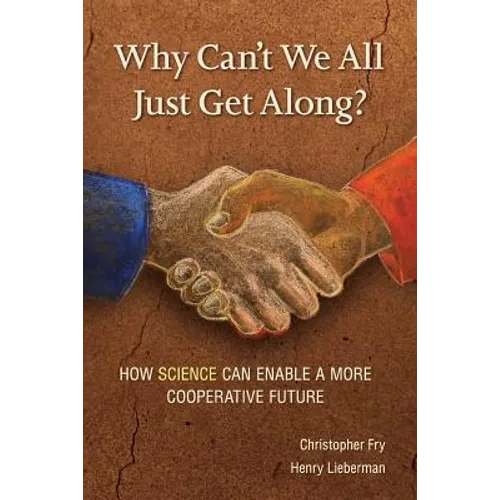
Our goal is outrageous: solve the world's major social problems. Our strategy starts with bringing you on an exploration that includes identifying the big problems, analyzing underlying causes, recognizing commonalities, and providing solutions that address root causes.
We hope you'll find insightful solutions that are, at least unconventional, perhaps even innovative. This means they are, by and large, not proven. If you said we're skating on thin ice, you'd be correct; but we're going to lace up anyway. The temporary band-aids of conventional wisdom are not working. Band-aids may simply fill a niche precluding real solutions. All that's necessary for the bad guys to win is for the good guys to be distracted with the insufficient. The clock is ticking.
The first part, What keeps us from getting along? presents our fundamental argument, drawing from mathematics, psychology, and evolutionary theory. It gives you the tools for thinking about the rest of the issues we will cover.
The second part, Does human nature allow us to get along? debunks arguments that say that aggression, conflict, greed, and war are inevitable. This stance of inevitability is perhaps the biggest obstacle we have, since if you believe something is inevitable, you won't be motivated to change it. Sure, there's plenty of history that might make you pessimistic. But we claim that these negative tendencies are due to scarcity and societal conditions. We now have the technology to change them.
The third part is Can we get along economically?. The economy has been an unending source of conflict, as, after thousands of years, we still struggle to provide enough for everybody. Today's economic systems, Capitalism and Communism, were the economic technologies of the Industrial Revolution era. That era is drawing to a close, and those systems are now obsolete. If we play our cards right, AI and personal manufacturing will usher in the next era, which we call Makerism.
In Can government help us get along? we rethink the role of governments as a vehicle for making collective decisions in society. Representative democracy as practiced in the USA is considered the "gold standard", but like the gold standard for money, maybe there's now another way. We present a proposal which we call Reasonocracy, inspired by the collaborative processes of the scientific community instead of the competitive, power-based processes of today's governments.
Finally, in How can we get along in....? we give our prescriptions for making a more cooperative society in a number of specific areas. Education. Justice. Guns. Transportation. Infrastructure. These flesh out some concrete solutions to contemporary issues, inspired by our principles.
We are not on a sustainable path. Whether current trends end in chaos or not is up to us. Join us on a journey through solution-space, where we challenge the assumption that adversarial and competitive structures are necessary to get things done.