Product Description
by Philip D. Wingeier-Rayo (Author), Justo L. Gonzalez (Foreword by)
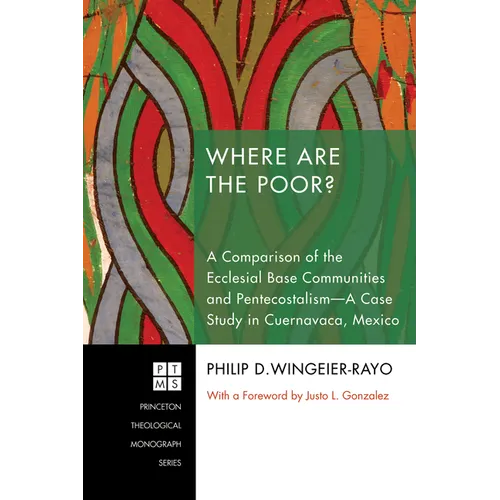
Description: The Ecclesial Base Communities (CEBs) emerged in the wake of Latin American liberation theology and are often referred to as ""the Church of the Poor."" This book, however, addresses whether or not CEBs are indeed the Church of the Poor today. It is an open question now if Pentecostalism has in fact become the new church of the poor. To answer this question Philip Wingeier-Rayo conducted a one-year ethnographic study of both movements in a marginalized barrio in Cuernavaca, Mexico. Using the anthropological method of participant-observer, the author studied a Roman Catholic Church and a Pentecostal Church--just 100 yards apart--compiling surveys, life interviews, and field notes to relay his findings. For those interested in liberation theology, Pentecostalism, new religious movements, or the influence of religion on society, this in-depth ethnographic study will be of great interest. Endorsements: ""Based on his varied experience in Latin America and informed by the vast literature on emergent forms of Christianity in Central and South America, Wingeier-Rayo has undertaken a careful study of neighboring examples of what are sometimes seen as opposed forms of Christianity: the base communities associated with Liberation Theology and the Pentecostal movement. Refusing facile dichotomies and generalizations this study will be of considerable help to anyone who wants to understand contemporary Christianity."" --Theodore W. Jennings Jr. Professor of Biblical and Constructive Theology Chicago Theological Seminary ""Dr. Wingeier-Rayo brings a wealth of experience in cross-cultural ministry to bear on a topic of truly global significance. His close analysis of two very distinctive traditions of faith, in one particular context, shatters stereotypes and celebrates diverse gifts. We need more contextual studies like this one to open our eyes to the kaleidoscopic nature of God's reign."" --Paul Chilcote Professor of Historical Theology & Wesley Studies Ashland Theological Seminary About the Contributor(s): Philip Wingeier-Rayo is Associate Professor of Religion at Pfeiffer University where he teaches in the areas of theology, missions, and cultural anthropology. He is the author of Cuban Methodism (Dolphins & Orchids, 2006).
Author Biography
Philip Wingeier-Rayo is Associate Professor of Religion at Pfeiffer University where he teaches in the areas of theology, missions, and cultural anthropology. He is the author of Cuban Methodism (Dolphins & Orchids, 2006).