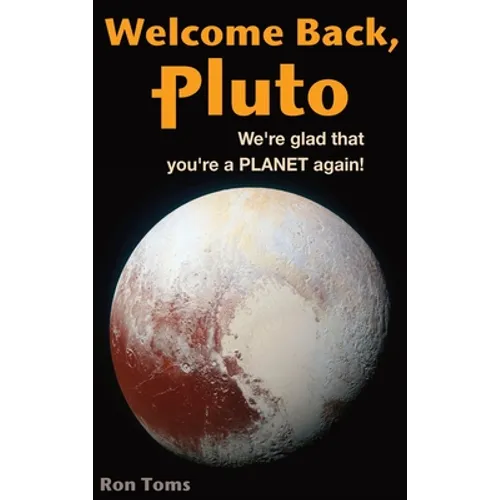
Product Description
by Ron Toms (Author)
We call them strawberries, even though they are not berries. Scientifically, they're not even a fruit. Tomatoes are technically a fruit, but tomato paste is legally classified as a vegetable. If we're being scientific, peanuts are not nuts, and hermit crabs are not crabs. So why is it so important that Pluto can't be called a planet?
Don't blame science. Do you know the scientific definition of a metal? Or a continent? or a mountain? Or a river? Or a species? Or a civilization? It turns out, none of these words have any scientifically rigorous definitions.
Do we need a rigorous, scientific definition for the word "planet"? Maybe not.
The vast majority of planetary scientists recognize a subtle truth about the IAU's definition; it's about as useful as the fuzzy green casserole leftovers from last month growing in the back of someone's fridge. It should be thrown out with the garbage. In terms of scientific utility, it is utterly worthless.
When it comes to defining terms that don't need to be defined, or naming insignificant things like the 97,058th asteroid, the IAU is very persnickety. But when it comes to naming the largest features in the solar system, like the Kuiper Belt, it seems that no one is in charge. Most astronomers agree that Kuiper was the wrong name for it. Gerard Kuiper wasn't the first to describe it, didn't discover any Kuiper Belt objects, and believed it didn't even exist. So how did we get stuck with that name?
Why was it so important to change the status of Pluto, but not fix this blunder? If Pluto is just another Kuiper Belt object, then Clyde Tombaugh discovered the first Kuiper Belt Object when he discovered Pluto. Maybe the Kuiper Belt should be called the Tombaugh Belt. There are political forces within the IAU to prevent that from happening, but politics should have no place in science.
If we are going to be scientific, we must also give up the obvious falsehood that the four gas giants belong in the same category as the four terrestrial planets. Literally everything about them is different, often by orders of magnitude. Composition, density, scale, topology, celestial neighborhoods... These are clearly two separate categories of things. Putting them in the same category is profoundly bad science. The only similarity they share is that they look like stars when viewed from Earth with naked eyes.
Regarding the status of Pluto, there is only one obvious solution to this conundrum. The word 'planet' belongs more to the realm of history and literature than to science. We must divorce the word 'planet' from any hard, rigorous scientific meaning.
We can do better. Biology, chemistry, meteorology and more have logical and useful systems of taxonomy, while astronomy's taxonomy is an ad-hoc kludge. This book does not solve that problem. It only exposes the truth of it and suggests ideas for other people to ponder. Perhaps one of those people can become the Carl Linnaeus of astronomy.