


Product Description
by Ruth R. Ealy (Author), David G. Thomas (Editor)
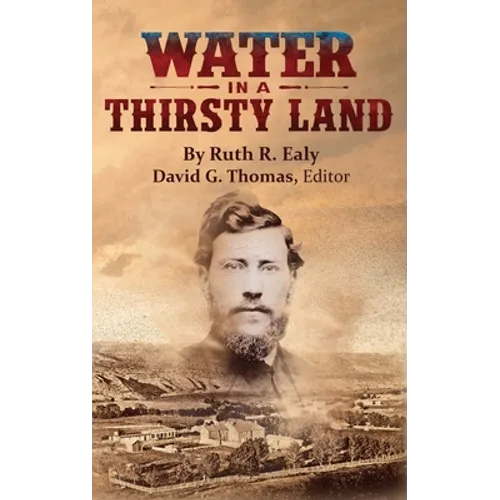
"Water in a Thirsty Land" is a chronicle of Dr. Taylor Filmore Ealy's 1874 to 1881 sojourn as a medical missionary in Indian Territory (Oklahoma) and New Mexico Territory, compiled by his daughter Ruth R. Ealy, and privately issued in a limited edition of 40 copies.
The sources of Ruth's account are her father's extensive, contemporaneous diaries and his recollections and correspondence.
Dr. Ealy's first assignment was Fort Arbuckle, Chickasaw Reservation, Oklahoma Territory. His second was Lincoln, New Mexico Territory. His final assignment was Zuni Pueblo, New Mexico Territory.
Dr. Ealy's faithful accounts of his struggles and challenges at these -- at the time -- exotic locations make for fascinating reading. His daily records of eye-witnessed events in Lincoln are of exceptional historical value. He arrived in Lincoln on February 19, 1878, the day after John Henry Tunstall was murdered. The unprovoked, sadistic murder of Tunstall kicked off the bloody Lincoln County War. Dr. Ealy was present at Tunstall's funeral, the killing of Lincoln County Sheriff Brady and Deputy Hindman, and the five-day shootout that ended with the firing of Alexander McSween's home and the heinous slaughtering of McSween and four others as they frantically fled the blazing conflagration.
There are many details about the Lincoln County War in Dr. Ealy's account that are not recorded in other sources. Here are examples:
- Tunstall's funeral was held at 3 pm. His bullet-holed, bloody clothes were lying on the dirty ground in McSween's back yard during the service.
- The Lincoln county jail when Sheriff Brady was shot was "a hole in the ground with a watch-tower over it."
- Sheriff Brady had handcuffs in his pocket when he was shot.
- The book provides many details about Tunstall's store: "The floors were good ones and the windows were large." One room was "12 feet high, 18 feet long, and 18 feet wide, with a huge window and a door with a large glass in it." That room was "large enough to hold three hundred people." The store lot was five acres in size and fully fenced.
- Two of McSween's front windows were shot out on the second day of the 5-day shootout in Lincoln.
- When the McSween house was fired during that 5-day shootout, one of Elizabeth Shield's children stepped in the coal oil used to ignite the fire.
- Among the items in McSween's house destroyed by the fire were an elegant piano, a Brussels carpet, costly furniture, rich curtains, and fine paintings.
- McSween was buried wrapped in a sheet supplied by Mary Ealy.
- After the Ealys fled Lincoln for Fort Stanton, they were ordered by the Fort Commander, Colonel Dudley, to not talk about the events they witnessed in Lincoln.
- After Taylor testified at the Dudley Court of Inquiry, he was warned by anonymous note that he would be killed before he got back to his home in Zuni (a "coffin note").
From Lincoln, Dr. Ealy went to Zuni Pueblo. There, he entered a long-isolated, deeply ethnocentric world that had not changed for hundreds of years. His keen observations are one of the primary, early sources of halcyon life in Zuni in 1878.
Dr. Ealy was in Zuni when the first James Stevenson anthropological expedition arrived in New Mexico. He knew well pioneer ethnologists such as Frank Hamilton Cushing, Matilda Coxe Stevenson, and Alfred Kroeber. He was present when John Karl Hillers took his famous photographs of Zuni Pueblo.
The Editor has added an extensive introduction, contextual notes, footnotes, appendices, and an index to the text of this extremely rare book.
Supplementing the text are 45 photos, including many photos never published before.



