Skip to content
Save 5% on your next order with code PREMIUM5!
100,000+ Products for Home, Medical, Office & Classroom Needs
Search
Skip to product information
1 of 1

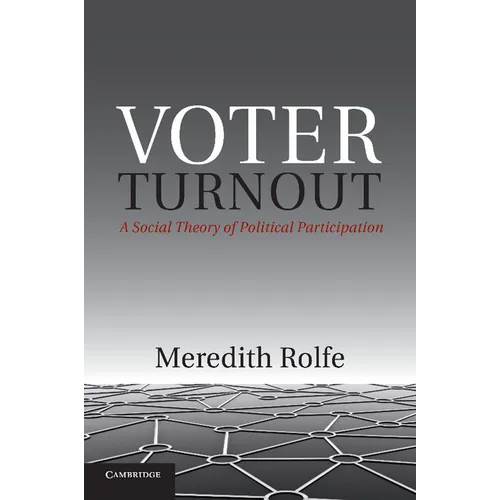
Voter Turnout: A Social Theory of Political Participation - Paperback

$52.02 USD
$52.02 USD
Sale Sold out
Shipping calculated at checkout.
In stock (100 units), ready to be shipped

Available Offers

Fast delivery available on most orders

Multiple secure payment options accepted

Secure checkout with
  • American Express
  • Apple Pay
  • Diners Club
  • Discover
  • Google Pay
  • Mastercard
  • PayPal
  • Shop Pay
  • Visa

Flight Range: Up to 1,000 meters (3,280 feet)

Maximum Speed: 45 kilometers per hour (28 miles per hour)

For all orders exceeding a value of 100USD shipping is offered for free.

Returns will be accepted for up to 10 days of Customer’s receipt or tracking number on unworn items. You, as a Customer, are obliged to inform us via email before you return the item.

Otherwise, standard shipping charges apply. Check out our delivery Terms & Conditions for more details.

View Product Details
Shopping cart
Product Product subtotal Quantity Price Product subtotal
Voter Turnout: A Social Theory of Political Participation - Paperback
$52.02/ea
$0.00
$52.02/ea $0.00

Product Description

by Meredith Rolfe (Author)

This book develops and empirically tests a social theory of political participation. It overturns prior understandings of why some people (such as college-degree holders, churchgoers, and citizens in national rather than local elections) vote more often than others. The book shows that the standard demographic variables are not proxies for variation in the individual costs and benefits of participation, but for systematic variation in the patterns of social ties between potential voters. Potential voters who move in larger social circles, particularly those including politicians and other mobilizing actors, have more access to the flurry of electoral activity prodding citizens to vote and increasing political discussion. Treating voting as a socially-defined practice instead of as an individual choice over personal payoffs, a social theory of participation is derived from a mathematical model with behavioral foundations that is empirically calibrated and tested using multiple methods and data sources.


Number of Pages: 248
Dimensions: 0.56 x 9 x 6 IN
Publication Date: August 22, 2013
you might like