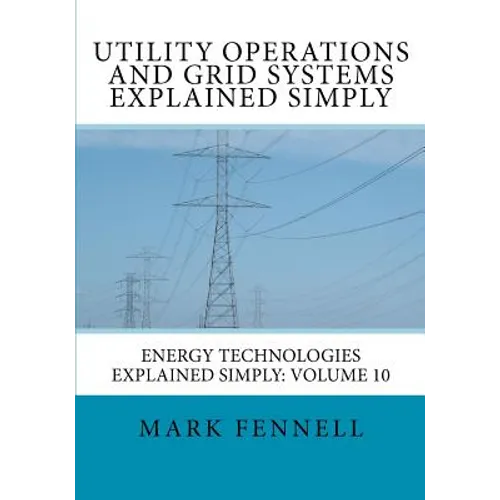
Product Description
by Mark Fennell (Author)
Utilities and power grids may seem complex, yet this book will guide you easily through the mysteries. In this book you will learn the basic operations of utilities and the basic operations of grids. You will learn how power is traded in the power markets. You will learn how utilities and grids maintain quality control, including how they monitor the flow of power and how they make adjustments as needed. You will learn how power failures occur and how we can minimize power failures in the future. You will also learn a great deal about the future of power distribution, particularly in the areas of distributed generation and smart grids. No technical background is required; this book will explain everything you need to know about the operation of utilities and power grids in a way that any reader can understand. This book is designed for policy-makers, community activists, and curious citizens. This book is also designed as an essential reference for energy technology students and for anyone working in the electrical power industry. 10.1 Utility Company Operation Basics The first chapter provides an overview of utility operation, focusing on quality control for utilities. This chapter discusses in detail how to ensure that there is enough power to meet demand at any given time. 10.2 Monitoring and Communications Systems The second chapter discusses monitoring and communication systems. This chapter explains the SCADA system, including the components and operation. This chapter also explains the types of translation devices and the options for communication methods. 10.3 Quality Control for Utilities causes, effects, and protection against significant variations for each factor. 10.4 Basic Concepts of Grids Chapter four provides a broad perspective of grids, with further clarification by comparing grids to the highway system. You will learn the possible players in a grid and their roles. You will learn the jobs of the grid manager. A major section of this chapter is where you will learn the advantages and disadvantages of grids, followed by an overview of an ideal grid system. 10.5 Grid Operations In chapter five we go step by step through the sequence of grid operations. By the end of this chapter you will understand the details of grid operation, including several common variations. 10.6 Quality Control for Grids Chapter six discusses grid failures and quality control for grids. In this chapter you will learn how blackouts occur and how we can prevent them. The majority of chapter six provides detailed explanations of how to maintain quality control in any grid system, and thereby prevent power outages. You will learn about reliability oversight organizations such as NERC, FERC, and ERO. You will also learn the major sections of the Energy Policy Act of 2005 (most of which relate to reliability). 10.7 Smart Grids Chapter seven discusses "Smart Grids". There are numerous technologies associated with the term "smart grid", therefore chapter seven begins with an overview of smart grids, followed by an overview of smart grid technologies. Much of this chapter is devoted to the proper and improper uses of smart grid technologies. 10.8 The Future of Electrical Distribution The final chapter discusses the future of electrical distribution. This is a very important chapter because the paths we take when developing power distribution systems will affect our safety, reliability, and economic security for many years. Therefore, this chapter explains the visions for the future of electrical distribution, followed by detailed descriptions. This chapter also discusses some additional features which are valuable for the ideal future of electrical distribution.
Author Biography
Mark Fennell is an author, educator, and public speaker. He specializes in explaining complex information in ways that anyone can understand. He has also made significant discoveries in the areas of energy and electromagnetism. Mark has an M.S. in Energy Technologies with additional technical studies in Environmental Science, Industrial Hygiene, and HazMat Response. He has also studied law, world religions, and government operations. Through his own research and travels Mark has become one of the foremost experts in Energy Technologies - including fundamental properties of electricity, environmental effects of energy sources, and the future of power grids. Mark has also become one of the foremost experts in Electromagnetic Energy, having made numerous discoveries in the fundamental nature and creative application of EM Energies. Mark has published more than 50 books. He has also given dozens of presentations and taught hundreds of students. His teaching style (whether in person or in print) is informal, conversational, and inspirational. His books, classes, and presentations remain consistently popular. Mark continues to educate the public on a variety of topics. For more information on his Energy Technology Classes visit http: //EnergyTechnologySimply.blogspot.com. For updates on his discoveries, writings, and other activities visit his Facebook page "Intelligent Community Solutions".