Skip to content
Save 5% on your next order with code PREMIUM5!
100,000+ Products for Home, Medical, Office & Classroom Needs
Search
Skip to product information
1 of 1

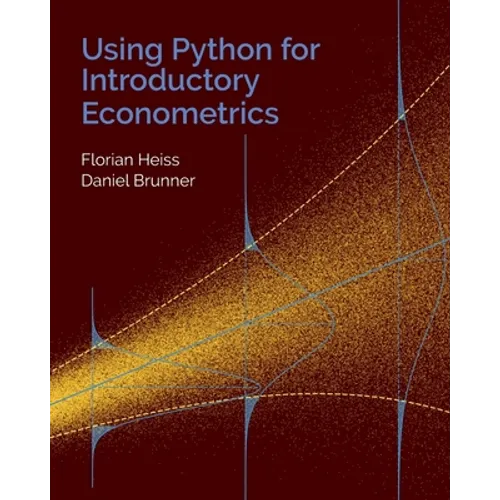
Using Python for Introductory Econometrics - Paperback

$36.32 USD
$36.32 USD
Sale Sold out
Shipping calculated at checkout.
In stock (100 units), ready to be shipped

Available Offers

Fast delivery available on most orders

Multiple secure payment options accepted

Secure checkout with
  • American Express
  • Apple Pay
  • Diners Club
  • Discover
  • Google Pay
  • Mastercard
  • PayPal
  • Shop Pay
  • Visa

Flight Range: Up to 1,000 meters (3,280 feet)

Maximum Speed: 45 kilometers per hour (28 miles per hour)

For all orders exceeding a value of 100USD shipping is offered for free.

Returns will be accepted for up to 10 days of Customer’s receipt or tracking number on unworn items. You, as a Customer, are obliged to inform us via email before you return the item.

Otherwise, standard shipping charges apply. Check out our delivery Terms & Conditions for more details.

View Product Details
Shopping cart
Product Product subtotal Quantity Price Product subtotal
Using Python for Introductory Econometrics - Paperback
$36.32/ea
$0.00
$36.32/ea $0.00

Product Description

by Daniel Brunner (Author), Florian Heiss (Author)

  • Introduces the popular, powerful and free programming language and software package Python
  • Focus: implementation of standard tools and methods used in econometrics
  • Compatible with "Introductory Econometrics" by Jeffrey M. Wooldridge in terms of topics, organization, terminology and notation
  • Companion website with full text, all code for download and other goodies

Topics:

  • A gentle introduction to Python
  • Simple and multiple regression in matrix form and using black box routines
  • Inference in small samples and asymptotics
  • Monte Carlo simulations
  • Heteroscedasticity
  • Time series regression
  • Pooled cross-sections and panel data
  • Instrumental variables and two-stage least squares
  • Simultaneous equation models
  • Limited dependent variables: binary, count data, censoring, truncation, and sample selection
  • Formatted reports using Jupyter Notebooks
Number of Pages: 430
Dimensions: 0.87 x 10 x 8 IN
Publication Date: May 25, 2020
you might like