Skip to content
Welcome To Our Store.
100,000+ Products for Home, Medical, Office & Classroom Needs
Search
Skip to product information
1 of 1

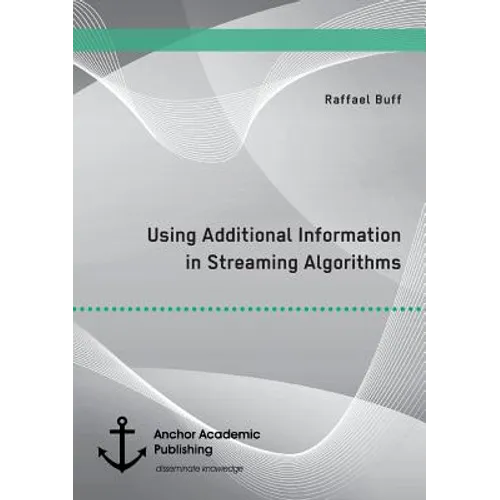
Using Additional Information in Streaming Algorithms - Paperback

$147.02 USD
$147.02 USD
Sale Sold out
Shipping calculated at checkout.
In stock (100 units), ready to be shipped

Available Offers

Fastest Delivery Tomorrow With Vip DealOrder within 1 hr 8 mins.

Instant 10% Discount On HDFC Banks Credit/Debit Cards EMI and CreditCard

Secure checkout with
  • American Express
  • Apple Pay
  • Diners Club
  • Discover
  • Google Pay
  • Mastercard
  • PayPal
  • Shop Pay
  • Visa
  • Daily deals
  • Return policy
  • Payment method
  • Help center 24/7

Flight Range: Up to 1,000 meters (3,280 feet)

Maximum Speed: 45 kilometers per hour (28 miles per hour)

For all orders exceeding a value of 100USD shipping is offered for free.

Returns will be accepted for up to 10 days of Customer’s receipt or tracking number on unworn items. You, as a Customer, are obliged to inform us via email before you return the item.

Otherwise, standard shipping charges apply. Check out our delivery Terms & Conditions for more details.

View Product Details
Shopping cart
Product Product subtotal Quantity Price Product subtotal
Using Additional Information in Streaming Algorithms - Paperback
$147.02/ea
$0.00
$147.02/ea $0.00

Product Description

by Raffael Buff (Author)

Streaming problems are algorithmic problems that are mainly characterized by their massive input streams. Because of these data streams, the algorithms for these problems are forced to be space-efficient, as the input stream length generally exceeds the available storage. The goal of this study is to analyze the impact of additional information (more specifically, a hypothesis of the solution) on the algorithmic space complexities of several streaming problems. To this end, different streaming problems are analyzed and compared. The two problems "most frequent item" and "number of distinct items", with many configurations of different result accuracies and probabilities, are deeply studied. Both lower and upper bounds for the space and time complexity for deterministic and probabilistic environments are analyzed with respect to possible improvements due to additional information. The general solution search problem is compared to the decision problem where a solution hypothesis has to be satisfied.

Number of Pages: 132
Dimensions: 0.28 x 8.27 x 5.83 IN
Publication Date: June 28, 2017
you might like