


Product Description
by Douglas J. Mudgway (Author)
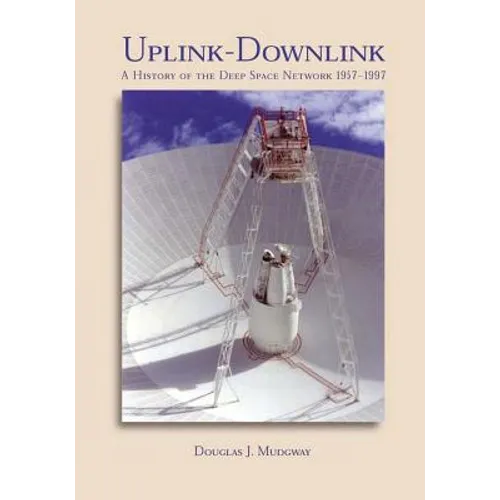
From the very beginning of its association with NASA in 1958, the Jet Propulsion Laboratory UPL) received its fair share of public recognition for its successes and failures in pursuing the exploration of deep space. It started with the Explorers, the first American satellites to orbit Earth. Later there came the Rangers, the first spacecraft to reach the surface of the Moon; the Mariner spacecraft, first to visit Venus and Mars; and the Voyagers that pushed the boundaries of deep space communication further out to Jupiter and Saturn, and eventually to Uranus and Neptune. There were other spacecraft that put landers, probes, or orbiters into planetary orbits or atmospheres, or onto planetary surfaces. There were probes whose mission was to explore the composition and dynamics of the interplanetary medium, and probes to observe the physics of the Sun. There were the huge missions, such as Viking to Mars, Galileo to Jupiter, and Cassini to Saturn, and there were small missions like Pathfinder to Mars and the New Millennium missions to asteroids and comets. There was also science that did not require a spacecraft for its experiments such as radio astronomy, radar astronomy, and the search for extraterrestrial intelligence. The public accolades that were engendered by the bountiful science returned from all of these NASA projects were shared by NASA and the scientists whose exquisite instruments and innovative interpretation of the data produced the new knowledge reflected in their results. However, what the press conferences, news releases, and media coverage did not reveal was the incredibly complex infrastructure that made each of these marvelous deep space missions possible. This infrastructure, which had been built over the years at JPL, included the Deep Space Network (DSN), an essential, integral part of every mission. There was, in effect, a relationship between the planetary missions, the spacecraft that carried them out, and the Deep Space Network that enabled such missions to be planned in the first place. Without the remarkable improvement in performance of the DSN, scientific missions to the distant planets would have been impossible. In 1964, when Mariner IV flew past Mars and took a few photographs, the limitation of the communication link meant that it took eight hours to return to Earth a single photograph from the Red Planet. By 1989, when Voyager observed Neptune, the DSN capability had increased so much that almost real-time video could be received from the much more distant planet, Neptune. It is timely that, some 40 years after its inception, the Deep Space Network should be recognized for its remarkable litany of progress in radio communications over vast distances, thereby allowing planetary scientists to collect data from sites throughout the solar system. This book succeeds in bringing the history of the DSN forward for the attention of curious, generally informed, or technical specialist readers. Uplink-Downlink transforms the technical records of a major NASA facility, unique in the world, into a viable historical narrative covering 40 years of its critical involvement in the United States space program. The Deep Space Network emerges from this study not only as a complex, human-machine system of worldwide dimensions, but also, more convincingly, as a focus for the aspirations of the NASA scientists for ever-bigger science, and of the JPL engineers for ever-greater innovation and enterprise in navigating to distant targets and communicating at ever-greater data-rates, in spite of the fluctuations in available NASA funding for both, driven in some measure by the conflicting priorities of the piloted versus unpiloted programs within NASA itself.



