Product Description
by Association O American Medical Colleges (Author)
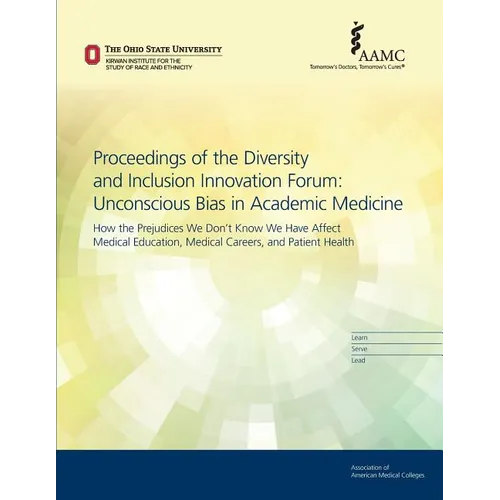
With input from national experts, this publication was developed by the AAMC and The Kirwan Institute for the Study of Race and Ethnicity at The Ohio State University. The report details the impact of unconscious bias on seven areas of academic medicine-patient care, medical school admissions, undergraduate medical education, resident and faculty recruitment, faculty mentoring, and faculty advancement, promotion and tenure. The publication also summarizes interventions that are being used to remediate these biases. Key insights include:
- Admissions committee members may sometimes unconsciously create different sets of criteria for students based on their experiences.
- The unconscious biases of peers and teachers can produce lasting effects on students' academic experiences.
- Unconscious bias can affect the faculty recruitment process even before positions are advertised.
- Patient care can improve when physicians explore their own biases and how these tendencies affect the care they provide.
- There is ample evidence that interventions can attenuate and even reverse unconscious bias.
Testimony for this publication was collected from the Diversity and Inclusion Innovation Forum, jointly sponsored by the Association of American Medical Colleges and The Kirwan Institute for the Study of Race and Ethnicity at The Ohio State University.
ABOUT THE AAMCThe AAMC (Association of American Medical Colleges) is a nonprofit association dedicated to transforming health through medical education, health care, medical research, and community collaborations. Its members are all 155 accredited U.S. and 17 accredited Canadian medical schools; approximately 400 teaching hospitals and health systems, including Department of Veterans Affairs medical centers; and more than 70 academic societies. Through these institutions and organizations, the AAMCleads and serves America's medical schools and teaching hospitals and the millions of individuals employed across academic medicine, including more than 186,000 full-time faculty members, 86,000 medical students, 145,000 resident physicians, and 60,000 graduate students and postdoctoral researchers in the biomedical sciences. Additional information about the AAMC is available ataamc.org.