


Product Description
by Megan Kate Nelson (Author)
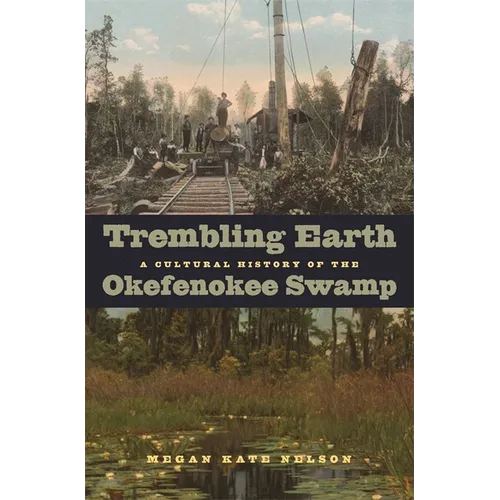
This innovative history of the Okefenokee Swamp reveals it as a place where harsh realities clashed with optimism, shaping the borderland culture of southern Georgia and northern Florida for over two hundred years.
From the formation of the Georgia colony in 1732 to the end of the Great Depression, the Okefenokee Swamp was a site of conflict between divergent local communities. Coining the term "ecolocalism" to describe how local cultures form out of ecosystems and in relation to other communities, Megan Kate Nelson offers a new view of the Okefenokee, its inhabitants, and its rich and telling record of thwarted ambitions, unintended consequences, and unresolved questions. The Okefenokee is simultaneously terrestrial and aquatic, beautiful and terrifying, fertile and barren. This peculiar ecology created discord as human groups attempted to overlay firm lines of race, gender, and class on an area of inherent ambiguity and blurred margins. Rice planters, slaves, fugitive slaves, Seminoles, surveyors, timber barons, Swampers, and scientists came to the swamp with dreams of wealth, freedom, and status that conflicted in varied and complex ways. Ecolocalism emerged out of these conflicts between communities within the Okefenokee and other borderland swamps. Nelson narrates the fluctuations, disconnections, and confrontations embedded in the muck of the swamp and the mire of its disorderly history, and she reminds us that it is out of such places of intermingling and uncertainty that cultures are forged.Front Jacket
This innovative history of the Okefenokee Swamp reveals it as a place where harsh realities clashed with optimism, shaping the borderland culture of southern Georgia and northern Florida for over two hundred years.
From the formation of the Georgia colony in 1732 to the end of the Great Depression, the Okefenokee Swamp was a site of conflict between divergent local communities. Coining the term "ecolocalism" to describe how local cultures form out of ecosystems and in relation to other communities, Megan Kate Nelson offers a new view of the Okefenokee, its inhabitants, and its rich and telling record of thwarted ambitions, unintended consequences, and unresolved questions.
The Okefenokee is simultaneously terrestrial and aquatic, beautiful and terrifying, fertile and barren. This peculiar ecology created discord as human groups attempted to overlay firm lines of race, gender, and class on an area of inherent ambiguity and blurred margins. Rice planters, slaves, fugitive slaves, Seminoles, surveyors, timber barons, Swampers, and scientists came to the swamp with dreams of wealth, freedom, and status that conflicted in varied and complex ways. Ecolocalism emerged out of these conflicts between communities within the Okefenokee and other borderland swamps.
Nelson narrates the fluctuations, disconnections, and confrontations imbedded in the muck of the swamp and the mire of its disorderly history, and she reminds us that it is out of such places of intermingling and uncertainty that cultures are forged.
Author Biography
Megan Kate Nelson is a writer, historian, and cultural critic. Based in Lincoln, Massachusetts, she has written about Civil War and western history for a number of national publications. Nelson also writes a regular column on Civil War popular culture, "Stereoscope," for Civil War Monitor, and her blog, Historista examines the "surprising and weird ways that people engage with history in everyday life." Nelson is also the author of Ruin Nation: Destruction and the American Civil War (Georgia). She has taught at Texas Tech University; California State University, Fullerton; Harvard University; and Brown University.



