Product Description
by The World Bank (Author)
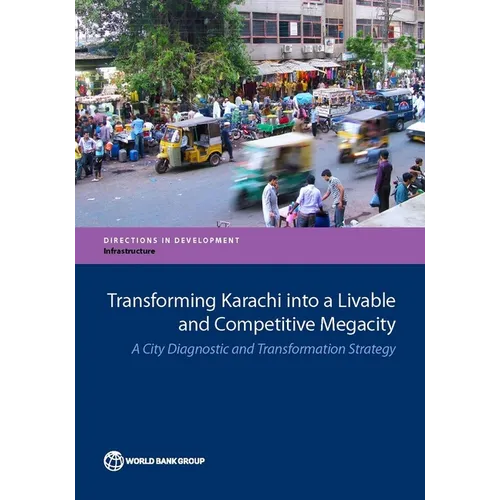
With a population of 16 million, Karachi is the largest megacity in Pakistan. Despite being a large city that is home to many, it has seen a substantial decline in quality of life and economic competitiveness in recent decades. Basic service delivery is very poor, with very low indicators for water supply, sanitation, public transport and public spaces. Pollution levels are high, and the city is vulnerable to disasters and climate change. A highly complex political economy, institutional fragmentation, land contestation, crime and security issues and social exclusion exacerbate these issues and make city management challenging. The Karachi City Diagnostic and Transformation Strategy attempts to present detailed data on the economy, livability and key urban services of the city, by identifying and quantifying the requirements to bridge the services gap in the city. It also proposes pathways towards the transformation of Karachi into a more livable, inclusive and economically competitive city by outlining policy actions that the city can undertake. The first part of the report provides an in-depth review of Karachi and is organized into three themes focused on key aspects of city management: (i) city growth and prosperity - discussing city economy, competitiveness, business environment and poverty; (ii) city livability - discussing urban and spatial planning, urban governance and municipal service delivery (water and sanitation, public transport and solid waste); and (iii) sustainability and inclusiveness - discussing the city's long term resilience based on fiscal management, disaster resilience and climate change, and social inclusion. In each section, a diagnostic is provided on the issues, along with possible prioritized actions to resolve them. The second part of the report concludes by identifying four pillars for city transformation. These include: (i) building inclusive, coordinated and accountable institutions; (ii) greening Karachi for sustainability and resilience; (iii) leveraging on the city's economic, social and environmental assets; and (iv) creating a smart city through smart policies and technology.
Author Biography
The World Bank came into formal existence in 1945 following the international ratification of the Bretton Woods agreements. It is a vital source of financial and technical assistance to developing countries around the world. The organization's activities are focused on education, health, agriculture and rural development, environmental protection, establishing and enforcing regulations, infrastructure development, governance and legal institutions development. The World Bank is made up of two unique development institutions owned by its 185 Member Countries. The International Bank for Reconstruction and Development (IBRD) focuses on middle income and creditworthy poor countries and the International Development Association (IDA), which focuses on the poorest countries in the world.