


Product Description
by Centers for Disease Cont And Prevention (Author), Department of Health and Human Services (Author)
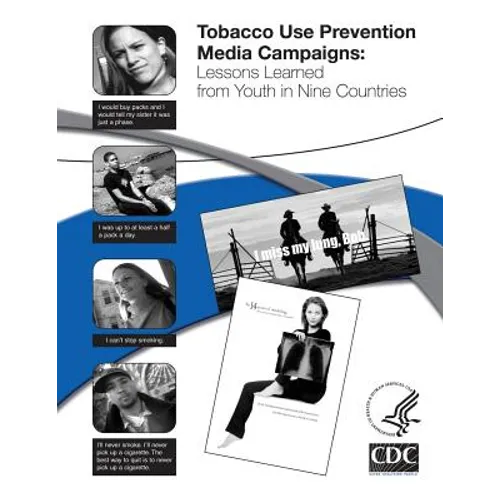
Globally, 4.9 million deaths a year are attributed to tobacco-related diseases (World Health Organization, 2005). If tobacco use continues unchecked, this rate is projected to rise to 10 million deaths annually by 2020. To help stem this alarming increase in tobacco-related mortality, governments should help reduce the number of young smokers because most smokers initiate tobacco use in their youth. One way to reduce the number of young smokers is to help youth make a commitment to not smoking (U.S. Department of Health and Human Services, 1994). Mass media provide effective tools for convincing youth not to smoke, because they can communicate prevention messages directly to young people and influence their knowledge, attitudes, and behaviors (Hopkins et al., 2001). By using mass media as part of a comprehensive tobacco control program, several countries have been successful in reaching and influencing youth with messages that encourage a commitment to not smoking. As part of its overall goal of reducing tobacco use, the Office on Smoking and Health of the Centers for Disease Control and Prevention (CDC) has prepared this report to build awareness of what the tobacco control community has learned about effective youth tobacco use prevention media campaigns. By combining field-based information with published research results, we aim to provide a collection of practical findings in a resource for those charged with developing and implementing effective mass media campaigns to reduce youth tobacco use. We reviewed evaluation data on campaigns from Australia, Canada, England, Finland, the Netherlands, Norway, Poland, Scotland, and the United States. We summarize the elements of paid media campaigns in these countries that, based on available information from both published and unpublished sources, appear to have been most effective in changing youth attitudes about smoking, encouraging youth to commit to not smoking and, in some cases, reducing tobacco use. We focus on lessons learned about ad message con-tent, format, and tone, as well as how often and how long ads should be aired. We also discuss the role of evaluation in developing effective media campaigns. This is not a meta-analysis or a comprehensive review of the scientific literature on media campaigns in tobacco control. Rather, it is a review of selected studies and campaign information provided by researchers and practitioners in tobacco control programs who responded to a request for information or were identified through our efforts to find others involved in youth tobacco use prevention media campaigns in various countries. We recognize that mass media are only part of the total plan needed to reduce youth tobacco use. School-based education and youth empowerment programs, and cessation programs, for example, can play important roles in the overall effectiveness of youth tobacco use prevention programs. However, evaluations of paid mass media campaigns, especially those focused on television ads, have produced the most consistent data available regarding message effectiveness. Therefore, in this review, we focus on findings from evaluations of television ads used in paid mass media campaigns.



