


Product Description
by Robert Mitchell (Author), Catherine Waldby (Author)
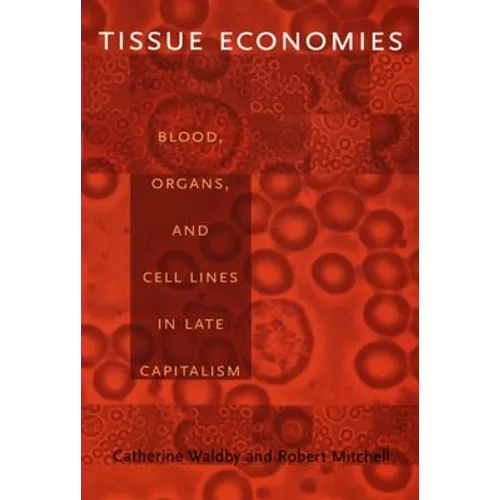
As new medical technologies are developed, more and more human tissues--such as skin, bones, heart valves, embryos, and stem cell lines--are stored and distributed for therapeutic and research purposes. The accelerating circulation of human tissue fragments raises profound social and ethical concerns related to who donates or sells bodily tissue, who receives it, and who profits--or does not--from the transaction. Catherine Waldby and Robert Mitchell survey the rapidly expanding economies of exchange in human tissue, explaining the complex questions raised and suggesting likely developments. Comparing contemporary tissue economies in the United Kingdom and United States, they explore and complicate the distinction that has dominated practice and policy for several decades: the distinction between tissue as a gift to be exchanged in a transaction separate from the commercial market and tissue as a commodity to be traded for profit.
Waldby and Mitchell pull together a prodigious amount of research--involving policy reports and scientific papers, operating manuals, legal decisions, interviews, journalism, and Congressional testimony--to offer a series of case studies based on particular forms of tissue exchange. They examine the effect of threats of contamination--from HIV and other pathogens--on blood banks' understandings of the gift/commodity relationship; the growth of autologous economies, in which individuals bank their tissues for their own use; the creation of the United Kingdom's Stem Cell bank, which facilitates the donation of embryos for stem cell development; and the legal and financial repercussions of designating some tissues "hospital waste." They also consider the impact of different models of biotechnology patents on tissue economies and the relationship between experimental therapies to regenerate damaged or degenerated tissues and calls for a legal, for-profit market in organs. Ultimately, Waldby and Mitchell conclude that scientific technologies, the globalization of tissue exchange, and recent anthropological, sociological, and legal thinking have blurred any strict line separating donations from the incursion of market values into tissue economies.
Back Jacket
Tissue Economies" asks us to think about biological materials as inseparable from the networks of exchange, gift, and excess that condition their value to us. Catherine Waldby and Robert Mitchell show us a new body politic, one in which the organs, tissues, and fluids exist as much outside of and between bodies as they do within them."--Eugene Thacker, author of "The Global Genome: Biotechnology, Politics, and Culture"
Author Biography
Catherine Waldby teaches medical sociology at the University of New South Wales. She is the author of The Visible Human Project: Informatic Bodies and Posthuman Medicine and AIDS and the Body Politic: Biomedicine and Sexual Difference.
Robert Mitchell is Assistant Professor of English at Duke University. He is a coeditor of Data Made Flesh: Embodying Information and Semiotic Flesh: Information and the Human Body.



