Product Description
by Dolores Bausum (Author)
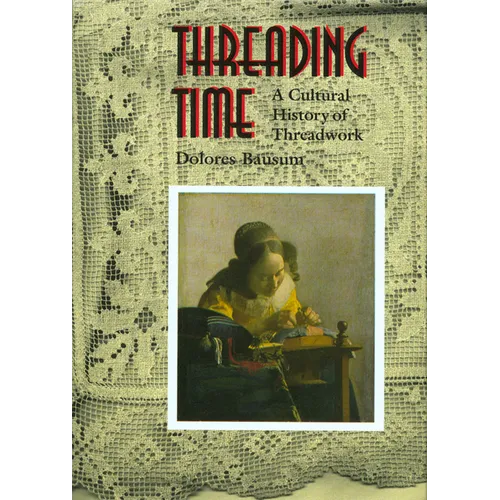
In a ground-breaking survey taken primarily from literary sources, Threading Time reveals the essential link between the human spirit and the art of connecting threads. Whether looking at stories about clothing made in the Garden of Eden, a medieval manuscript, or modern fiction and poetry, the author traces the importance to humankind of a craft that has never ceased since it began at least forty thousand years ago. The author's conception of threadwork throughout is generic, including all kinds of work done with thread, yarn, or fiber.
In the author's long-range view, threadwork becomes more than a garment, a rug, or a tapestry on the wall. It is often a bond shared with contemporaries and with ancestors, a link between humans and cultural beliefs, even a tie between humankind and the Divine. This age-old association of interwoven fibers and humanity is found today in a metaphor that is used to convey the concept of shared traditions, values, and beliefs: the fabric of society. A rip in the fabric can be alarming; mending it is necessary to avert instability and even chaos. Threading Time opens with stories from biblical traditions that continue to influence society. Next come portrayals of threadworkers in Greek and Roman myths and those suggested on the famous marble frieze carved on the Parthenon of Athens. The author then turns to Piers Plowman, Chartres Cathedral's windows, the Bayeux Tapestry, and other textile evidence from the medieval era; she suggests how threadwork in those centuries became identified with spiritual faith and belief in miracles. An illustrated French manuscript and the Apocalypse Tapestry highlight a discussion of changes in the lives of cloth workers that occurred during the Renaissance. Works by two Germans--playwright Gerhart Hauptmann and artist Käthe Kollwitz--illustrate labor struggles that persisted for centuries in textile production. Selections of poetry by English poets such as Robert Burns and William Blake provide glimpses of protests made by some against economic forces disrupting the lives of textile workers during the Industrial Revolution. Novels by Nathaniel Hawthorne, Edith Wharton, and D. H. Lawrence suggest that threadwork activity itself may arouse, release, or inhibit strong feelings, even erotic passion, between men and women. These novels also demonstrate that needlework and its products can be used to stigmatize, ostracize, or control an individual. Both fictional and real-life accounts follow in a discussion of works by three nineteenth-century writers--Charles Dickens, Louisa May Alcott, and Mary Boykin Chesnut--who illustrate the power of threadwork during wartime to transform solitary individuals into patriots and lift the morale of civilians who share common beliefs and objectives. Novels by Edith Gaskell, Edith Wharton, and Theodore Dreiser, as well as several memoirs, offer examples of textile work that individuals have done in peacetime when their daily survival hung by a thread. Finally, the author turns to twentieth-century American authors Margaret Mitchell, Alice Walker, Anna Quindlen, and John Updike for glimpses into families whose members are linked by threadwork. As an original view of threadwork written from a broad chronological perspective, Threading Time will appeal to textile artisans and collectors. It will also interest lay readers of literature, women's history, and cultural history.Author Biography
Dolores Bausum and her husband, Henry, a retired professor of history from the Virginia Military Institute, traveled extensively for many years. During these travels Bausum found herself increasingly interested in collecting fabric folk art. In 1985 she began designing quilts and locating superior quilters, eventually establishing a shop, Quilters of Virginia, in Lexington, Virginia. Works from her shop were included in the U.S. State Department's Art in Embassies Program and displayed abroad in two American embassy residences. The Bausums make their home in Beloit, Wisconsin.