Product Description
by Dominic Boyer (Editor), James D. Faubion (Editor), George E. Marcus (Editor)
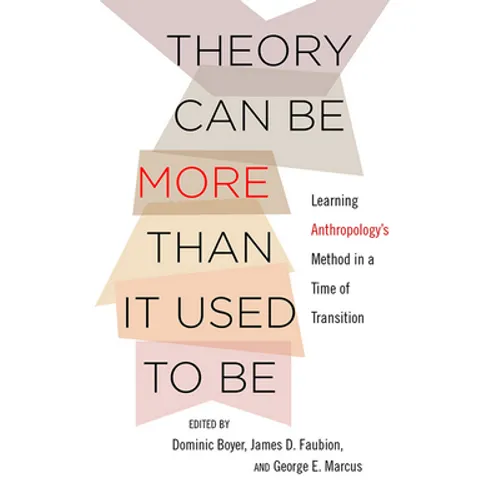
Within anthropology, as elsewhere in the human sciences, there is a tendency to divide knowledge making into two separate poles: conceptual (theory) vs. empirical (ethnography). In Theory Can Be More than It Used to Be, Dominic Boyer, James D. Faubion, and George E. Marcus argue that we need to take a step back from the assumption that we know what theory is to investigate how theory--a matter of concepts, of analytic practice, of medium of value, of professional ideology--operates in anthropology and related fields today. They have assembled a distinguished group of scholars to diagnose the state of the theory-ethnography divide in anthropology today and to explore alternative modes of analytical and pedagogical practice.Continuing the methodological insights provided in Fieldwork Is Not What It Used to Be, the contributors to this volume find that now is an optimal time to reflect on the status of theory in relation to ethnographic research in anthropology and kindred disciplines. Together they engage with questions such as, What passes for theory in anthropology and the human sciences today and why? What is theory's relation to ethnography? How are students trained to identify and respect anthropological theorization and how do they practice theoretical work in their later career stages? What theoretical experiments, languages, and institutions are available to the human sciences? Throughout, the editors and authors consider theory in practical terms, rather than as an amorphous set of ideas, an esoteric discourse of power, a norm of intellectual life, or an infinitely contestable canon of texts. A short editorial afterword explores alternative ethics and institutions of pedagogy and training in theory.Contributors: Andrea Ballestero, Rice University; Dominic Boyer, Rice University; Lisa Breglia, George Mason University; Jessica Marie Falcone, Kansas State University; James D. Faubion, Rice University; Kim Fortun, Rensselaer Polytechnic Institute; Andreas Glaeser, University of Chicago; Cymene Howe, Rice University; Jamer Hunt, Parsons The New School for Design and the Institute of Design in Umea, Sweden; George E. Marcus, University of California, Irvine; Townsend Middleton, University of North Carolina at Chapel Hill; Deepa S. Reddy, University of Houston-Clear Lake; Kaushik Sunder Rajan, University of Chicago
Author Biography
Dominic Boyer is Professor of Anthropology and Director of the Center for Energy and Environmental Research in the Human Sciences at Rice University. He is the author of The Life Informatic: Newsmaking in the Digital Era; Spirit and System: Media, Intellectuals, and the Dialectic in Modern German Culture; and Understanding Media: A Popular Philosophy. James Faubion is the Radoslav Tsanoff Chair and Professor of Anthropology at Rice University. He is the author of An Anthropology of Ethics, The Shadows and Lights of Waco: Millennialism Today, and Modern Greek Lessons: A Primer in Historical Constructivism. George E. Marcus is Chancellor's Professor of Anthropology at the University of California, Irvine. He is coauthor of Anthropology as Cultural Critique: An Experimental Moment in the Human Sciences and coeditor of Writing Culture: The Poetics and Politics of Ethnography. He was the founding editor of Cultural Anthropology.