Skip to content
Welcome To Our Store.
100,000+ Products for Home, Medical, Office & Classroom Needs
Search
Skip to product information
1 of 2

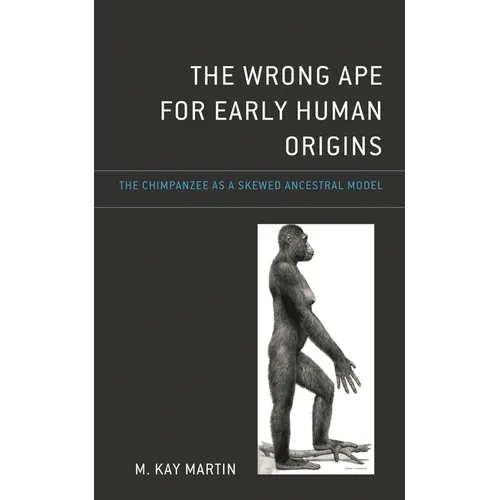
The Wrong Ape for Early Human Origins: The Chimpanzee as a Skewed Ancestral Model - Hardcover

$198.00 USD
$198.00 USD
Sale Sold out
Shipping calculated at checkout.
In stock (100 units), ready to be shipped

Available Offers

Fast delivery available on most orders

Multiple secure payment options accepted

Secure checkout with
  • American Express
  • Apple Pay
  • Diners Club
  • Discover
  • Google Pay
  • Mastercard
  • PayPal
  • Shop Pay
  • Visa

Flight Range: Up to 1,000 meters (3,280 feet)

Maximum Speed: 45 kilometers per hour (28 miles per hour)

For all orders exceeding a value of 100USD shipping is offered for free.

Returns will be accepted for up to 10 days of Customer’s receipt or tracking number on unworn items. You, as a Customer, are obliged to inform us via email before you return the item.

Otherwise, standard shipping charges apply. Check out our delivery Terms & Conditions for more details.

View Product Details
Shopping cart
Product Product subtotal Quantity Price Product subtotal
The Wrong Ape for Early Human Origins: The Chimpanzee as a Skewed Ancestral Model - Hardcover
$198.00/ea
$0.00
$198.00/ea $0.00

Product Description

by M. Kay Martin (Author)

The Wrong Ape for Early Human Origins examines ways in which the chimpanzee referential model has exerted a primary influence on evolutionary theory, dominating portraits of proto- and early human social life, and in the broader sense, of human nature itself. Evidence on which this model is based is revisited, along with new cross-disciplinary findings that point to alternative scenarios for hominin phylogeny, ecology and subsistence, primeval kinship, cognition and language, and the respective roles played by aggression and cooperation as evolutionary drivers. Recent advances in phylogenetics, evolutionary biology, and new additions to the fossil record are rendering linear, monotypic models obsolete. Contemporary theories on species divergence and change over time are shifting attention from ancient genotypes to factors that influence gene expression, and from innate prescriptive behaviors to epigenesis and the capacity for behavioral plasticity. This broader platform has the potential to fundamentally revise current notions about the basic nature, phenotypic traits, and lifeways of ancestral humans. It informs a different profile of our progenitors--one that reflects greater ecological bandwidth, reliance on creative niche construction, and hominin agency in the structuring of ancient reproductive and social groups.

Author Biography

M. Kay Martin is a research anthropologist and author of Social DNA: Rethinking Our Evolutionary Past.


Number of Pages: 244
Dimensions: 0.69 x 9 x 6 IN
Publication Date: April 21, 2023
you might like
