Product Description
by Charles River (Author)
*Includes pictures
*Includes contemporary accounts
*Includes online resources and a bibliography for further reading
The Lewis and Clark Expedition, notwithstanding its merits as a feat of exploration, was also the first tentative claim on the vast interior and the western seaboard of North America by the United States. It set in motion the great movement west that began almost immediately with the first commercial overland expedition funded by John Jacob Astor's Pacific Fur Company and would continue with the establishment of the Oregon Trail and California Trail. That quest would reach its ultimate expression and its conclusion in 1869, when the last spike was driven into the Union Pacific Railroad.
The railroad system being laid down across the United States during the 1860s remain the very epitome of contradiction. On the one hand, it was a triumph of engineering skills over thousands of miles of rough terrain, but on the other hand, it drained the natural resources in those places nearly dry. It "civilized" the American West by making it easier for women and children to travel there, but it dispossessed Native American civilizations that had lived there for generations. It made the careers of many men and destroyed the lives from many others. It was bold and careless, ingenious and cruel, gentle and violent, and it enriched some and bankrupted others. In short, it was the best and worst of 19th century America in action.
As settlers pushed west and the Gold Rush brought an influx of Americans to California, the need for something like the Transcontinental Railroad was apparent to the government in the 1850s, and with the help of private companies, government officials conducted all kinds of land surveys in order to plot a course. Of course, even once routes chosen, the backbreaking work itself had to be done to connect railroad lines across the span of nearly 2,000 miles. This required an incredible amount of manpower, often consisting of unskilled laborers engaging in dangerous work, and the financial resources poured into it were also extreme. J. O. Wilder, a Central Pacific-Southern Pacific employee, described a typical scene: "The Chinese were as steady, hard-working a set of men as could be found. With the exception of a few whites at the west end of Tunnel No. 6, the laboring force was entirely composed of Chinamen with white foremen and a 'boss/translator'. A single foreman (often Irish) with a gang of 30 to 40 Chinese men generally constituted the force at work at each end of a tunnel; of these, 12 to 15 men worked on the heading, and the rest on the bottom, removing blasted material. When a gang was small or the men were needed elsewhere, the bottoms were worked with fewer men or stopped so as to keep the headings going."
Ultimately, the projects were considered so important that work on them progressed throughout the Civil War, and it took the better part of the 1860s before a grand system of rail lines was finally completed. Once they were in place, they proved a boon to building up the American West, especially the Southwest and Pacific Northwest in places like Nevada, Utah, Wyoming, Colorado, Oregon and Washington.
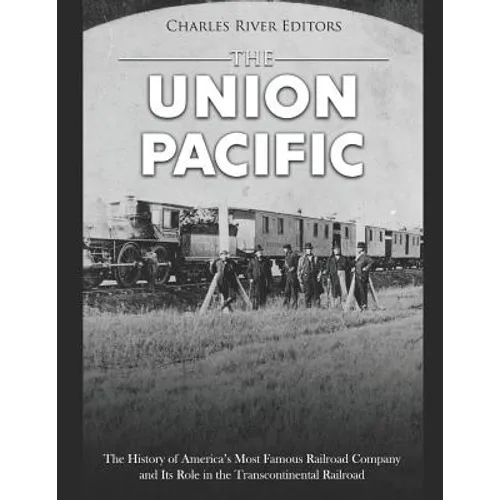
The Union Pacific: The History of America's Most Famous Railroad Company and Its Role in the Transcontinental Railroad examines how the Union Pacific was established and went on to become one of the most important companies in North America. Along with pictures depicting important people, places, and events, you will learn about the Union Pacific like never before.