


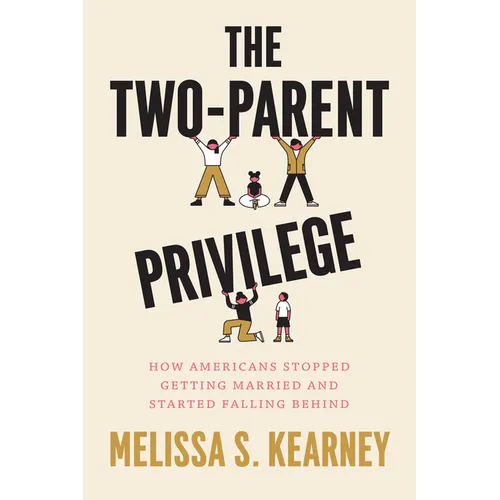
Product Description
by Melissa S. Kearney (Author)
The surprising story of how declining marriage rates are driving many of the country's biggest economic problems.
In The Two-Parent Privilege, Melissa S. Kearney makes a provocative, data-driven case for marriage by showing how the institution's decline has led to a host of economic woes--problems that have fractured American society and rendered vulnerable populations even more vulnerable. Eschewing the religious and values-based arguments that have long dominated this conversation, Kearney shows how the greatest impacts of marriage are, in fact, economic: when two adults marry, their economic and household lives improve, offering a host of benefits not only for the married adults but for their children. Studies show that these effects are today starker, and more unevenly distributed, than ever before. Kearney examines the underlying causes of the marriage decline in the US and draws lessons for how the US can reverse this trend to ensure the country's future prosperity. Based on more than a decade of economic research, including her original work, Kearney shows that a household that includes two married parents--holding steady among upper-class adults, increasingly rare among most everyone else--functions as an economic vehicle that advantages some children over others. As these trends of marriage and class continue, the compounding effects on inequality and opportunity grow increasingly dire. Their effects include not just children's behavioral and educational outcomes, but a surprisingly devastating effect on adult men, whose role in the workforce and society appears intractably damaged by the emerging economics of America's new social norms. For many, the two-parent home may be an old-fashioned symbol of the idyllic American dream. But The Two-Parent Privilege makes it clear that marriage, for all its challenges and faults, may be our best path to a more equitable future. By confronting the critical role that family makeup plays in shaping children's lives and futures, Kearney offers a critical assessment of what a decline in marriage means for an economy and a society--and what we must do to change course.Author Biography
Melissa S. Kearney is the Neil Moskowitz Professor of Economics at the University of Maryland, Director of the Aspen Economic Strategy Group, a research associate at the National Bureau of Economic Research, and a nonresident senior fellow at the Brookings Institution.
Number of Pages: 240
Dimensions: 0.53 x 8.96 x 6.15 IN
Publication Date: June 10, 2025