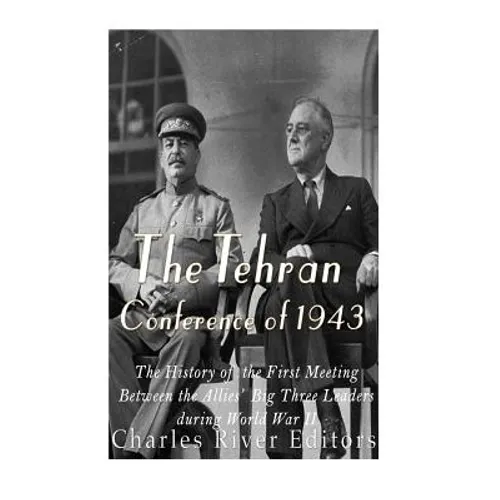
Product Description
by Charles River (Author)
*Includes pictures *Includes quotes from the leaders and accounts of the conference by participants *Includes online resources and a bibliography for further reading "We are sitting around this table for the first time as a family, with the one object of winning the war. ...] In such a large family circle we hope that we will be very successful and achieve a constructive accord in order that we may maintain close touch throughout the war and after the war." - Prime Minister William Churchill to President Franklin Roosevelt, Soviet premier Josef Stalin, and others at the Tehran Conference, November 28th, 1943 Separated by vast gulfs of political, cultural, and philosophical divergence, the three chief Allied nations of World War II - the United States, the Soviet Union, and Great Britain - attempted to formulate a joint policy through a series of three conferences during and immediately after the conflict. The first meeting took place in Tehran in late 1943, while the fate of World War II still hung in the balance. The fate of World War II hung in the balance in 1943. On the Eastern Front, the opposed juggernauts of the Wehrmacht, army of Adolf Hitler's Third Reich, and the Red Army, the military force of Josef Stalin's Soviet Union, grappled in a nearly apocalyptic battle. Black smoke rose into the steppe air from burning vehicles strewing the landscape, while millions of men maneuvered, fought, and died in a series of brutal encounters. Meanwhile, the Western Allies succeeded in ousting the Germans from North Africa, then took Sicily with Operation Husky and landed in Italy. There, the tough, hardened warriors of the German military turned the Italian peninsula into a vast fortress; these seasoned fighters made the determined Anglo-American forces pay a bitter price for each mountain ridge, river crossing, and stony valley swept by cunningly-placed gun emplacements. Nearing the end of the year, with the Axis halted but still terrifyingly powerful, and the fortunes of war appearing likely to swing either way, the Allies deemed it necessary for their leaders to meet, coordinating their war planning. Feelers for a conference went out from President Roosevelt as early as 1942, but profound differences between the purposes of the various Allies already appeared at that time. Stalin, in particular, wanted territorial gains for the Soviet Union, already looking hungrily at Poland, a notable ally of the Western powers. Accordingly, FDR reached out to Stalin for both cooperation and a summit: "Such a meeting of minds in personal conversation would be greatly useful in the conduct of the war against Hitlerism. Perhaps if things go as well as we hope, you and I could spend a few days together next summer near our common border off Alaska. But in the meantime, I regard it as of the utmost military importance that we have the nearest possible approach to an exchange of views." (Eubank, 1985, 46). Over 70 years later, the Tehran Conference is not as well known as the two major conferences that came after it - Yalta and Potsdam - but it had a profound influence in shaping the course of the rest of the war. While the conference took care of peripheral matters related to the region, particularly Turkey and Iran, and it touched upon the topics of fighting Japan and shaping the post-war world, the conference was most notable for its agreement to open up a second front against Nazi Germany in Western Europe, which even the Nazis figured would almost certainly take place somewhere in Vichy France. As a result, Tehran was instrumental in the coming operations that culminated with the D-Day invasion on June 6, 1944 and the rest of Operation Overlord. The Tehran Conference of 1943: The History of the First Meeting Between the Allies' Big Three Leaders during World War II looks at the crucial conference and its results, most notably the preparations for D-Day the following year.