


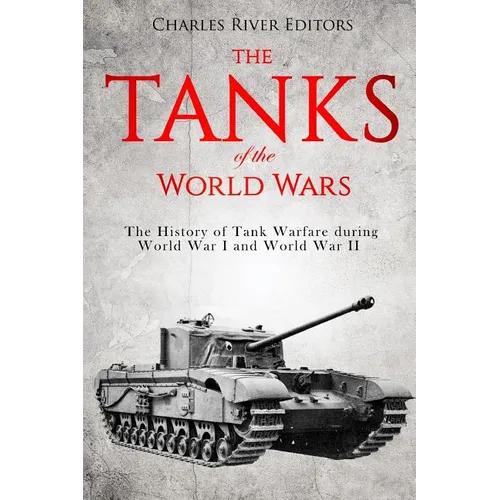
Product Description
by Charles River (Author)
*Includes pictures
*Includes accounts of the fighting
*Includes online resources and a bibliography for further reading
One of the most important breakthroughs in military technology associated with World War I, and certainly the one that continues to capture the public imagination, was the introduction of a war machine that came to dominate the face of land battles throughout most of the 20th century: the tank. As a concept, it was not revolutionary; in fact, it harkened back to classical antiquity and to the Middle Ages, such as the covered battering rams and testudos which had made frequent appearances on ancient battlefields. In essence, it was designed to solve the age-old problem of protecting infantry from enemy projectiles while remaining mobile.
The tanks of World War I, revolutionary (and initially terrifying) as they were, had their limitations. A standard tank would literally consume its own weight in spare parts, and they were painfully slow compared to more modern iterations. They were also lightly armed - usually with machine guns or light guns at most - and some poorly designed models tended to "ditch" themselves, sometimes irretrievably, in wider trenches. However, as a mobile bastion for infantry to shelter behind in the advance, and as a psychological weapon, they were significant.
All major powers, and many minor ones, learned their lesson in World War I. During the interwar period (late 1918 to mid-1939), a wide variety of tanks and antitank weapons were developed by a number of different countries, and those nations that did not have their own models hastened to purchase some from the more advanced countries. These tanks would shape the war that was to come.
World War II was thus the culmination of a quarter century of tank development, and it would also be the first major test of tanks in mobile warfare, during which they had to face other tanks. However, many of the tanks were constructed with the static warfare of the Western Front in mind and were thus slow and had short operational ranges. Others were too light to face opposing tanks or the new generation of anti-tank weapons that hadn't existed in World War I. The unsuitability of these tank models for this new kind of warfare was quickly recognized, and the belligerent powers scrambled to create better designs. As each new, improved model came off the assembly lines, the opposing powers rushed to create a tank that could beat it. In that regard, World War II was also a war between rival engineers.
The beginning of World War II found the major powers developing tanks to some extent, but lingering ideas from World War I affected the development of tanks during the Interwar period. As a result, aside from the blitzkrieg doctrine developed by the Nazis, tanks were still used in terms of infantry support, and there were few wars during this period to give strategists the chance to develop better uses for the new armored vehicles before World War II started. Commanders soon found that many of the tanks fielded in the campaigns of 1939-1941 lacked the necessary armor, guns, and designs.
Inevitably, tactics evolved throughout the war. The Germans were early leaders in tank tactics, as their successes from Poland through the opening phases of Operation Barbarossa demonstrated. The main German tank tactic was the so-called Schwerpunkt ("center of gravity"), in which a concentration of tanks achieved a local superiority, broke through, and drove deep behind enemy lines, carving up frontline enemy forces that could then be surrounded and taken out by support tanks, infantry, and artillery. This is why German tanks were built for speed while maintaining good armor and weaponry. Once the Allies witnessed the efficacy of German tank tactics, they began to imitate them, prompting the Germans to further refine their own techniques.



