Product Description
by David P. Barash (Author)
"An accessible, intriguing explanation of game theory . . . that can help explain much human behavior." -Seattle Post-Intelligencer
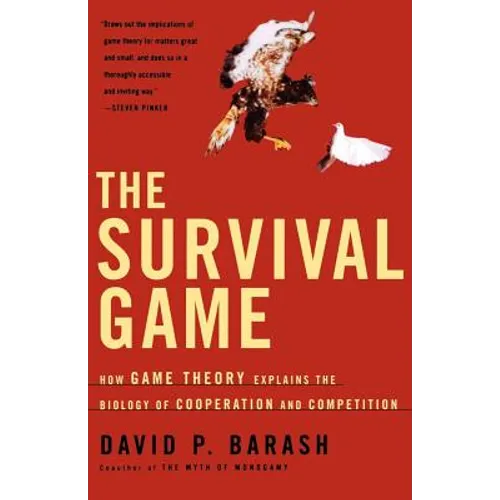
Humans, like bacteria, woodchucks, chimpanzees, and other animals, compete or cooperate in order to get food, shelter, territory, and other resources to survive. But how do they decide whether to muscle out or team up with the competition? In The Survival Game, David P. Barash synthesizes the newest ideas from psychology, economics, and biology to explore and explain the roots of human strategy. Drawing on game theory-the study of how individuals make decisions-he explores the give-and-take of spouses in determining an evening's plans, the behavior of investors in a market bubble, and the maneuvers of generals on a battlefield alongside the mating and fighting strategies of "less rational" animals. Ultimately, Barash's lively and clear examples shed light on what makes our decisions human, and what we can glean from game theory and the natural world as we negotiate and compete every day.Author Biography
A professor of psychology at the University of Washington in Seattle, zoologist David P. Barash is the author of more than a dozen books, including The Myth of Monogamy (0-8050-7136-9) and The Mammal in the Mirror. He lives in Redmond, Washington.
Number of Pages: 302
Dimensions: 0.9 x 8.3 x 5.5 IN
Publication Date: September 01, 2004