


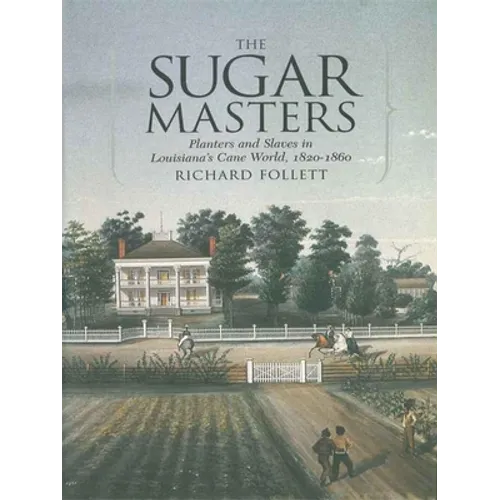
Product Description
by Richard Follett (Author)
Focusing on the master-slave relationship in Louisiana's antebellum sugarcane country, The Sugar Masters explores how a modern, capitalist mind-set among planters meshed with old-style paternalistic attitudes to create one of the South's most insidiously oppressive labor systems. As author Richard Follett vividly demonstrates, the agricultural paradise of Louisiana's thriving sugarcane fields came at an unconscionable cost to slaves.
Thanks to technological and business innovations, sugar planters stood as models of capitalist entrepreneurship by midcentury. But above all, labor management was the secret to their impressive success. Follett explains how in exchange for increased productivity and efficiency they offered their slaves a range of incentives, such as greater autonomy, improved accommodations, and even financial remuneration. These material gains, however, were only short term.
According to Follett, many of Louisiana's sugar elite presented their incentives with a "facade of paternal reciprocity" that seemingly bound the slaves' interests to the apparent goodwill of the masters, but in fact, the owners sought to control every aspect of the slaves's lives, from reproduction to discretionary income. Slaves responded to this display of paternalism by trying to enhance their rights under bondage, but the constant bargaining process invariably led to compromises on their part, and the grueling production pace never relented. The only respite from their masters' demands lay in fashioning their own society, including outlets for religion, leisure, and trade.
Until recently, scholars have viewed planters as either paternalistic lords who eschewed marketplace values or as entrepreneurs driven to business success. Follett offers a new view of the sugar masters as embracing both the capitalist market and a social ideology based on hierarchy, honor, and paternalism. His stunning synthesis of empirical research, demographics study, and social and cultural history sets a new standard for this subject.
Author Biography
Richard Follett teaches American history at the University of Sussex, England.



