


Product Description
by Lewis Mumford (Author), Nicole Pohl (Afterword by), Karen Christensen (Foreword by)
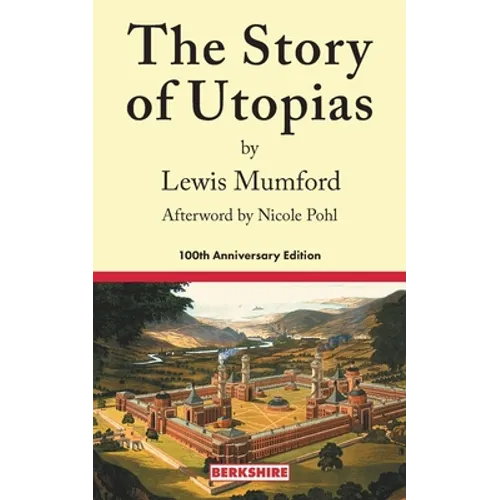
This survey of utopias, which spans from Plato to the twentieth century, was Lewis Mumford's first success. He was particularly interested in what he calls utopias of reconstruction, models for reshaping an imperfect world. Beginning with a survey of famous utopian ideas and writings, he moves from Plato's Republic, More's Utopia, Andre 's Christianopolis, Bacon's New Atlantis, Campanella's City of the Sun, Fourier's phalanxes, Cabet's Icaria, Bellamy's Looking Backward, Morris's News from Nowhere, and finally on to H.G. Wells's utopian fiction. He then produces the essence of a checklist for assessing how closely a society comes to utopian ideals, looking at work and standards of living, housing, democratic (or not) governance, sex and marriage, the raising of children, our relationship with nature, and the importance of the arts and creativity. A century later, the book stands not only as an introduction to the work of a maverick scholar who had worldwide influence, but also suggests ways to approach a future even more challenging than that faced by Mumford's post-war generation. Mumford delves into issues that remain relevant today: social equity in his chapter on the country house, for example, and the relationship between science and the arts in his concluding chapter about how we can find, or build, utopia.
Mumford was thinking, as many of us are, about the practical lessons offered by imagined utopias. He posits that there are utopias of escape and utopias of "reconstruction," and was particularly interested in these utopias of reconstruction, models for reshaping an imperfect world:
The utopia of reconstruction is what its name implies: a vision of a reconstituted environment which is better adapted to the nature and aims of the human beings who dwell within it than the actual one; and not merely better adapted to their actual nature, but better fitted to their possible developments. If the first utopia [of escape] leads backward into the utopian's ego, the second leads outward-outward into the world.
In contrast with The Waste Land by T. S. Eliot, also published in 1922 by Boni & Liveright and republished by Berkshire Publishing Group in 2022, The Story of Utopias is largely about this idea of reconstruction, rather than the disillusion that Eliot's poem so powerfully captures.



