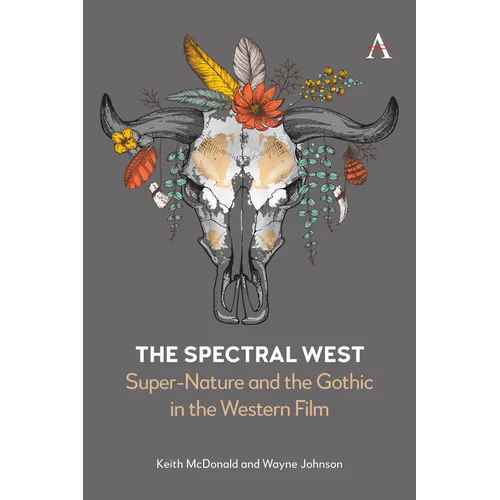
Product Description
by Keith McDonald (Author), Wayne Johnson (Author)
This book considers the presence of the supernatural and Gothic elements of the Western on screen. These dark and sinister undertones often exist in Western narratives to draw attention to the ever-present issue of death and its haunting resonance which characters encounter. This book examines this through key historic moments in Western film and its contemporary incarnations. The book detects imposing correlations in themes and currents between the Gothic and the Western relating to existential crisis and a loss of faith in ideologies and institutions. These themes represent the tensions between the old and the new, the deranged insistence on civility and order in a chaotic landscape, disillusionment and the shattering of faith in the natural order, and even nature and order themselves. The Western, just like the Gothic tale, reminds us that new frontiers are mired in the past, and optimism and survival are hunted down and haunted by guilt-ridden past and passed anxieties and traumas.
This book demonstrates and illuminates the uncanny coalition that can be seen between these two traditions epitomised in the tales of the spectral West. Take, for instance, the seminal psychological Western of the 1950s, The Searchers (1956), where the unspoken horrors of the past haunts the behaviour of the anti-hero, Ethan Edwards (played by John Wayne) and is an omnipresent as well as a daunting presence which looms throughout the narrative of the film; or Sicario (2016) where a naive FBI agent (played by Emily Blunt) is horrified by the malevolence of inhumanity which haunts borders in conflict and makes a mockery of morality. But most important to both films, as well as to countless others, is the brooding presence of the landscape itself, which intrudes like a spectral entity.
This tension has often presented a dilemma in such a recognisable genre. As Steve Neale has suggested, there is a problem with the 'central role of iconography in the Western'. It is as if, according to Neil Campbell, 'by the very nature of its mythic representations' there exists 'a type of hyper-reality, a simulation reproducing images conforming to some already defined, but possibly non-existent, sense of West-ness'. And yet, as the book demonstrates, rather than being hyper-real, and by definition not 'real', these mythic 'representations' are ghostly or spectral revenants. Through that process, we may then be able to distinguish, not indeed a problem or a dilemma, but a more deeply felt connection between the past and the present, between nature, space and time and any hope of a worthwhile future.
Author Biography
Keith McDonald holds a PhD from Birkbeck College, the University of London, and is an Associate Professor in Film Studies and Media at York St John University. He is the co-author of Guillermo del Toro: Film as Alchemic Art (2014) and Contemporary Gothic and Horror Film: Transnational Perspectives (2021).
Wayne Johnson is Senior Lecturer in Media and Film Studies at York St. John University. He received his PhD from Keele University. He is the co-author of Contemporary Gothic and Horror Film: Transnational Perspectives (2021) and co-editor of the Routledge Companion to Folk Horror (2024).