


Product Description
by Lingua Franca Magazine (Editor)
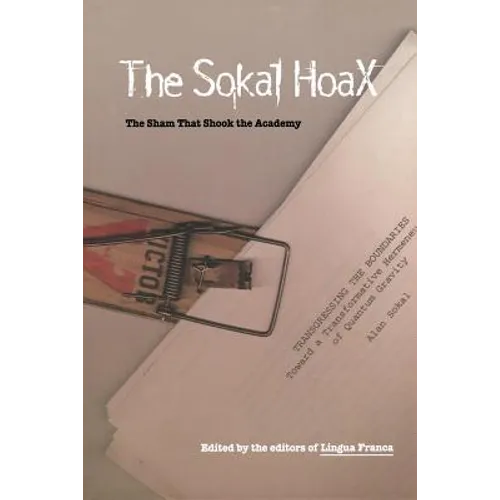
In May 1996 physicist Alan Sokal published an essay in the fashionable academic journal Social Text. The essay quoted hip theorists like Jacques Lacan, Donna Haraway, and Gilles Deleuze. The prose was thick with the jargon of poststructuralism. And the point the essay tried to make was counterintuitive: gravity, Sokal argued, was a fiction that society had agreed upon, and science needed to be liberated from its ideological blinders. When Sokal revealed in the pages of Lingua Franca that he had written the article as a parody, the story hit the front page of the New York Times. It set off a national debate still raging today: Are scholars in the humanities trapped in a jargon-ridden Wonderland? Are scientists deluded in thinking their work is objective? Are literature professors suffering from science envy? Was Sokal's joke funny? Was the Enlightenment such a bad thing after all? And isn't it a little bit true that the meaning of gravity is contingent upon your cultural perspective? Collected here for the first time are Sokal's original essay on "quantum gravity," his essay revealing the hoax, the newspaper articles that broke the story, and the angry op-eds, letters, and e-mail exchanges sparked by the hoax from intellectuals across the country, including Stanley Fish, George F. Will, Michael Bérubé, and Katha Pollitt. Also included are extended essays in which a wide range of scholars ponder the long-term lessons of the hoax.
Back Jacket
In May 1996 physicist Alan Sokal published an essay in the fashionable academic journal Social Text. The essay quoted hip theorists like Jacques Lacan, Donna Haraway, and Gilles Deleuze. The prose was thick with the jargon of poststructuralism. And the point the essay tried to make was counterintuitive: gravity, Sokal argued, was a fiction that society had agreed upon, and science needed to be liberated from its ideological blinders.
When Sokal revealed in the pages of Lingua Franca that he had written the article as a parody, the story hit the front page of the New York Times. It set off a national debate still raging today: Are scholars in the humanities trapped in a jargon-ridden Wonderland? Are scientists deluded in thinking their work is objective? Are literature professors suffering from science envy? Was Sokal's joke funny? Was the Enlightenment such a bad thing after all? And isn't it a little bit true that the meaning of gravity is contingent upon your cultural perspective?
Collected here for the first time are Sokal's original essay on "quantum gravity", his essay revealing the hoax, the newspaper articles that broke the story, and the angry op-eds, letters, and e-mail exchanges sparked by the hoax from intellectuals across the country, including Stanley Fish, George F. Will, Michael Berube, and Katha Pollitt. Also included are extended essays in which a wide range of scholars ponder the long-term lessons of the hoax.



