Product Description
by Orville E. Brown (Editor), Edward P. G. Seaga (Author)
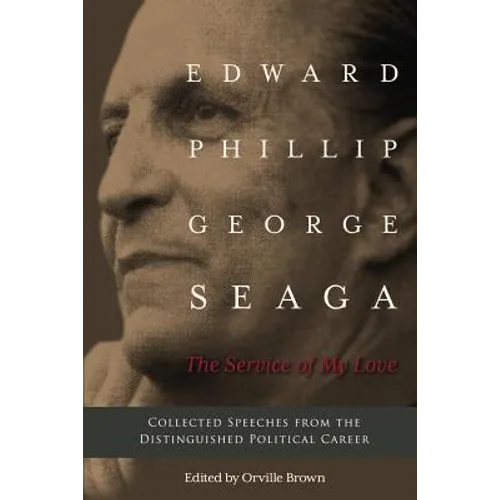
This book is a collection of speeches that mark the distinguished career of Edward Seaga, former Prime Minister of Jamaica, over a period of 45 years from his entry into the Legislative Council in 1959 until his resignation from the House of Representatives in 2004. In what was the longest tenure of any elected representative in the politics of modern Jamaica, Edward Seaga defined his mission from the start as a mission of social justice; to close the wide gulf that separated the rich and the poor, the haves and the have-nots, and create a more happy and balanced society. That vision shaped the highly successful first decade of independence when robust economic growth and programmes of social uplift produced a 50 percent improvement in the quality of working class life judged by access to education, jobs and the social services. His challenge in the second decade was to offer from opposition, a market-based growth alternative to the command policies of a socialist regime that was destroying the economy and dividing the society and finally produced a 25 percent decline in the quality of working class life. Seaga's challenge in these times was also to defend Jamaica's democratic institutions from a ruling party that wanted to turn democratic Jamaica into a one-party state on the Cuban model. Voted into power in 1980, Seaga returned the economy to growth and launched further social empowerment programmes. He was defeated in 1989 by neo-socialists who again ruined the economy because of their ignorance of the operation of market forces. In resigning his office in 2004 Seaga outlined to the ruling party the fundamental errors they had made and gave them a prescription for future economic success. Seaga made his mark internationally as a defender of democracy and as the man who led the forces that liberated the island of Grenada in 1983 when a socialist revolution turned on itself and the prime minister and his cabinet were assassinated. In addresses to the UN General Assembly in 1985 and the Commonwealth Prime Ministers' Conference in 1987, he argued persuasively that South Africa's apartheid system would not be destroyed by flights of rhetoric but by sanctions aimed at sharply reducing the value of the Rand to destroy its economic underpinnings. His thoroughly researched presentation convinced the UN and the Commonwealth Prime Ministers to maintain sanctions when other persuasive voices were arguing for their relaxation. He was proven right when the economic thrust finally brought an end to the oppressive system and freedom to 20,000, 000 black South Africans. Seaga's other passion was the encouragement of Jamaican culture because he understood its role in defining a people, in giving them a sense of self-worth and the confidence to take their place in the world. He returned to Jamaica the body of Marcus Garvey and created institutions for the celebration and preservation of Jamaican culture. In the 20 speeches listed, the most notable ones are The Haves and Have-Nots Speech, and three in which he eviscerates the socialist government, the first of which is titled, On a Collision Course With Bankruptcy. Also notable are the Social Wellbeing Speech, The Commonwealth Prime Ministers' speech and the penultimate, The Folk Roots of Jamaican Cultural Identity. The 1992 speech he made in the parliamentary tribute to Nelson Mandela in 1992 is so beautifully done that it should be placed among the great speeches that children are taught to recite. Among the tributes paid to Seaga on his retirement was one from pollster and social scientist, Carl Stone who wrote that no other Jamaican leader had created as many institutions or had left as much to posterity as Edward Seaga. His career was an act of love to the people of Jamaica that is best expressed in Sir Cecil Spring-Rice's song, I vow to thee my country, all earthly above, entire and whole and perfect, the service of my love.