Product Description
by Jon Lang (Author)
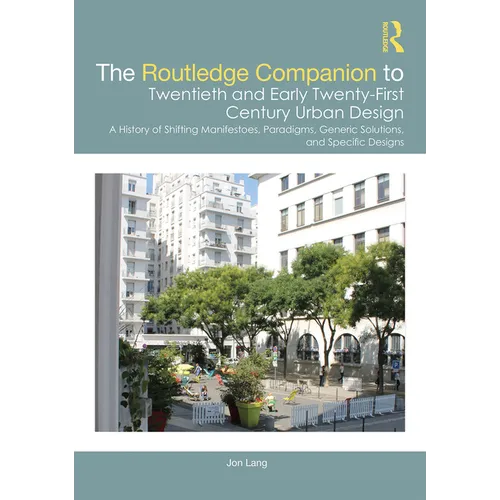
The Routledge Companion to Twentieth and Early Twenty-First Century Urban Design is a fully illustrated descriptive and explanatory history of the development of urban design ideas and paradigms of the past 150 years. The ideas and projects, hypothetical and built, range in scale from the city to the urban block level. The focus is on where the generic ideas originated, the projects that were designed following their precepts, the functions they address and/or afford, and what we can learn from them.
The morphology of a city--its built environment--evolves unselfconsciously as private and governmental investors self-consciously erect buildings and infrastructure in a pragmatic, piecemeal manner to meet their own ends. Philosophers, novelists, architects, and social scientists have produced myriad ideas about the nature of the built environment that they consider to be superior to those forms resulting from a laissez-faire attitude to urban development.
Rationalist theorists dream of ideal futures based on assumptions about what is good; empiricists draw inspirations from what they perceive to be working well in existing situations. Both groups have presented their advocacies in manifestoes and often in the form of generic solutions or illustrative designs. This book traces the history of these ideas and will become a standard reference for scholars and students interested in the history of urban spaces, including architects, planners, urban historians, urban geographers, and urban morphologists.
Author Biography
Jon Lang, Emeritus Professor, is the principal of his own consulting firm and formerly the director of urban design for ERG in Philadelphia, Pennsylvania. His consultancy work has taken him to all the continents of the world, except Antarctica. Born in India, he was educated in that country, England, South Africa, and the United States. He received his architectural degree from the University of the Witwatersrand and city planning from Cornell, where he also obtained his doctorate. Before settling in Australia in 1990, he headed the joint MArch/MCP Program in Urban Design at the University of Pennsylvania. At the University of New South Wales, he headed the School of Architecture and was the associate dean for research in the Faculty of the Built Environment in the 1990s and early 2000s. He has served as a visiting professor at universities in North and South America and Asia and has authored books on architectural theory, on urban design, and on modern architecture in India. His writings on urban design include Urban Design: The American Experience (1994), Urban Design: A Typology of Procedures and Products (2005; 2017), and, with Nancy Marshall, Urban Squares as Places, Links, and Displays (Routledge 2016). His book with Walter Moleski, Functionalism Revisited (2010), provides the intellectual basis for this endeavor. He has been a juror on several international urban design competitions. In 2010, he received the Reed and Malik Medal from the Institution of Civil Engineers in London.