Product Description
by Charles River (Author)
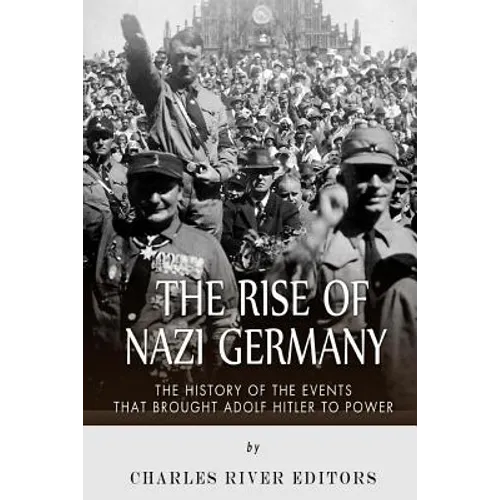
*Includes pictures *Profiles the seminal events that helped Hitler rise to power and consolidate his position, including the end of World War I, the Beer Hall Putsch, the Burning of the Reichstag, and the Night of the Long Knives *Includes online resources for further reading *Includes a table of contents "I cannot remember in my entire life such a change in the attitude of a crowd in a few minutes, almost a few seconds ... Hitler had turned them inside out, as one turns a glove inside out, with a few sentences. It had almost something of hocus-pocus, or magic about it." - Dr. Karl Alexander von Mueller It is often claimed that Adolf Hitler rose to power in Germany through democratic means, and while that is a stretch, it is true that he managed to become an absolute dictator as Chancellor of Germany in the 1930s through a mixture of politics and intimidation. Ironically, he had set such a course only because of the failure of an outright coup attempt known as the Beer Hall Putsch about a decade earlier. At the close of World War I, Hitler was an impoverished young artist who scrapped by through selling souvenir paintings, but within a few years, his powerful oratory brought him to the forefront of the Nazi party in Munich and helped make the party much more popular. A smattering of followers in the hundreds quickly became a party of thousands, with paramilitary forces like the SA backing them, and at the head of it all was a man whose fiery orations denounced Jews, communists and other "traitors" for bringing upon the German nation the Treaty of Versailles, which had led to hyperinflation and a wrecked economy. The early 1930s were a tumultuous period for German politics, even in comparison to the ongoing transition to the modern era that caused various forms of chaos throughout the rest of the world. In the United States, reliance on the outdated gold standard and an absurdly parsimonious monetary policy helped bring about the Great Depression. Meanwhile, the Empire of Japan began its ultimately fatal adventurism with the invasion of Manchuria, alienating the rest of the world with the atrocities it committed. Around the same time, Gandhi began his drive for the peaceful independence of India through nonviolent protests against the British. It was in Germany, however, that the strongest seeds of future tragedy were sown. The struggling Weimar Republic had become a breeding ground for extremist politics, including two opposed and powerful authoritarian entities: the right-wing National Socialists and the left-wing KPD Communist Party. As the 1930s dawned, these two totalitarian groups held one another in a temporary stalemate, enabling the fragile ghost of democracy to continue a largely illusory survival for a few more years. That stalemate was broken in dramatic fashion on a bitterly cold night in late February 1933, and it was the Nazis who emerged decisively as the victors. A single act of arson against the famous Reichstag building proved to be the catalyst that propelled Adolf Hitler to victory in the elections of March 1933, which set the German nation irrevocably on the path towards World War II. Like other totalitarian regimes, the leader of the Nazis kept an iron grip on power in part by making sure nobody else could attain too much of it, leading to purges of high-ranking officials in the Nazi party. Of these purges, the most notorious was the Night of the Long Knives, a purge in the summer of 1934 that came about when Hitler ordered the surprise executions of several dozen leaders of the SA. This fanatically National Socialist paramilitary organization had been a key instrument in overthrowing democratic government in Germany and raising Hitler to dictatorial power in the first place. However, the SA was an arm of the Nazi phenomenon which had socialist leanings and which was the private army of Ernst R hm, which was enough for Hitler to consider the organization dangerous.