Product Description
by Ellis S. Krauss (Author), Robert J. Pekkanen (Author)
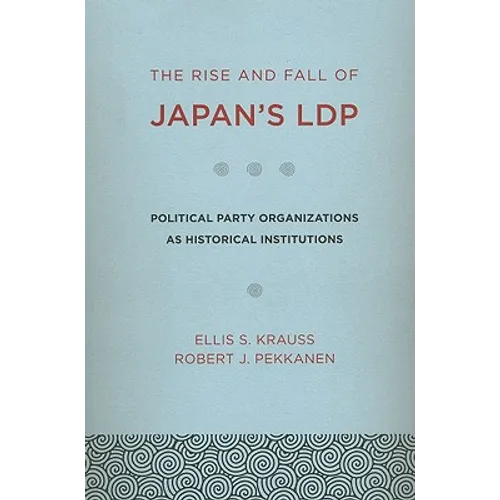
After holding power continuously from its inception in 1955 (with the exception of a ten-month hiatus in 1993-1994), Japan's Liberal Democratic Party (LDP) lost control of the national government decisively in September 2009. Despite its defeat, the LDP remains the most successful political party in a democracy in the post-World War II period. In The Rise and Fall of Japan's LDP, Ellis S. Krauss and Robert J. Pekkanen shed light on the puzzle of the LDP's long dominance and abrupt defeat. Several questions about institutional change in party politics are at the core of their investigation: What incentives do different electoral systems provide? How do politicians adapt to new incentives? How much does structure determine behavior, and how much opportunity does structure give politicians to influence outcomes? How adaptable are established political organizations?
The electoral system Japan established in 1955 resulted in a half-century of "one-party democracy." But as Krauss and Pekkanen detail, sweeping political reforms in 1994 changed voting rules and other key elements of the electoral system. Both the LDP and its adversaries had to adapt to a new system that gave citizens two votes: one for a party and one for a candidate. Under the leadership of the charismatic Koizumi Junichiro, the LDP managed to maintain its majority in the Japanese Diet, but his successors lost popular support as opposing parties learned how to operate in the new electoral environment. Drawing on the insights of historical institutionalism, Krauss and Pekkanen explain how Japanese politics functioned before and after the 1994 reform and why the persistence of party institutions (factions, PARC, koenkai) and the transformed role of party leadership contributed both to the LDP's success at remaining in power for fifteen years after the reforms and to its eventual downfall. In an epilogue, the authors assess the LDP's prospects in the near and medium term.
Author Biography
Ellis S. Krauss is Professor in the Graduate School of International Relations and Pacific Studies at the University of California, San Diego. He is the author of Broadcasting Politics in Japan: NHK and Television News, also from Cornell. Robert J. Pekkanen is Associate Professor and Chair of the Japan Studies program in the Jackson School of International Studies, University of Washington, and author of Japan's Dual Civil Society: Members without Advocates.