Skip to content
Welcome To Our Store.
100,000+ Products for Home, Medical, Office & Classroom Needs
Search
Skip to product information
1 of 1

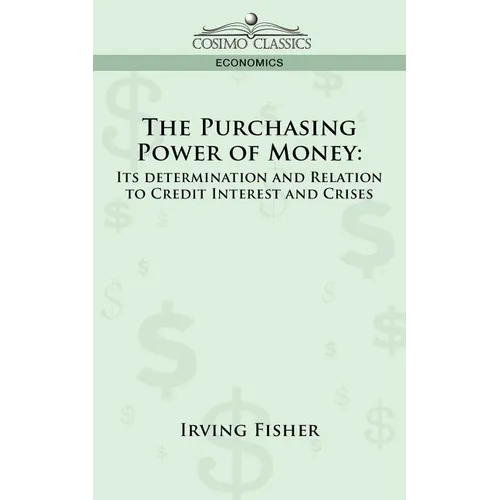
The Purchasing Power of Money: Its Determination and Relation to Credit Interest and Crises - Paperback

$38.86 USD
$38.86 USD
Sale Sold out
Shipping calculated at checkout.
In stock (100 units), ready to be shipped

Available Offers

Fastest Delivery Tomorrow With Vip DealOrder within 1 hr 8 mins.

Instant 10% Discount On HDFC Banks Credit/Debit Cards EMI and CreditCard

Secure checkout with
  • American Express
  • Apple Pay
  • Diners Club
  • Discover
  • Google Pay
  • Mastercard
  • PayPal
  • Shop Pay
  • Visa

Flight Range: Up to 1,000 meters (3,280 feet)

Maximum Speed: 45 kilometers per hour (28 miles per hour)

For all orders exceeding a value of 100USD shipping is offered for free.

Returns will be accepted for up to 10 days of Customer’s receipt or tracking number on unworn items. You, as a Customer, are obliged to inform us via email before you return the item.

Otherwise, standard shipping charges apply. Check out our delivery Terms & Conditions for more details.

View Product Details
Shopping cart
Product Product subtotal Quantity Price Product subtotal
The Purchasing Power of Money: Its Determination and Relation to Credit Interest and Crises - Paperback
$38.86/ea
$0.00
$38.86/ea $0.00

Product Description

by Irving Fisher (Author)

Of all wealth, man himself is a species. Like his horses or his cattle, he is himself a material object, and like them, he is owned: for if slave, he is owned by another, and if free, by himself. But though human beings may be considered as wealth, human qualities, such as skill, intelligence, and inventiveness, are not wealth. Just as the hardness of steel is not wealth, but merely a quality of one particular kind of wealth, -hard steel, -so the skill of a workman is not wealth, but merely a quality of another particular kind of wealth-skilled workman. Similarly, intelligence is not wealth, but an intelligent man is wealth. -from "Chapter I: Primary Definitions" Perhaps America's first celebrated economist, Irving Fisher-for whom the Fisher equation, the Fisher hypothesis, and the Fisher separation theorem are named-staked an early claim to fame with his revival, in this 1912 book, of the "quantity theory of money." An important work of 20th-century economics, this work explores: - the circulation of money against goods - the various circulating media - the mystery of circulating credit - how a rise in prices generates a further rise - influence of foreign trade on the quantity of money - the problem of monetary reform - and much more. AUTHOR BIO: American economist IRVING FISHER (1867-1947) was professor of political economy at Yale University. Among his many books are Mathematical Investigations in the Theory of Value and Prices (1892), The Rate of Interest (1907), Why Is the Dollar Shrinking? A Study in the High Cost of Living (1914), and Booms and Depressions (1932).


Number of Pages: 528
Dimensions: 1.18 x 8 x 5 IN
Publication Date: June 08, 2006
you might like
