


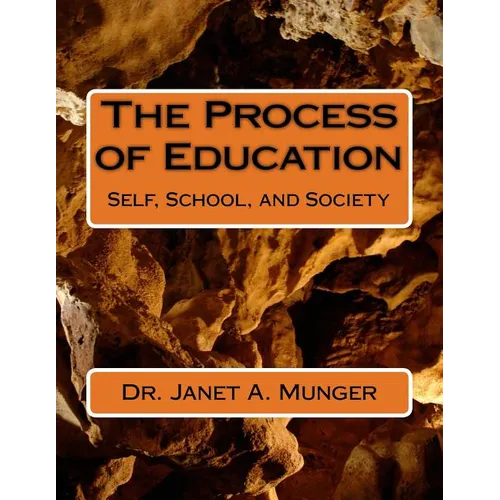
Product Description
by Janet a. Munger (Author)
FREE KINDLE W/ BOOK PURCHASE: This book is divided into 3 parts: (a) Self, School, & Society; (b) Selected Essays On Educational Policy & Management; (c) Leadership: School Principals Make a Huge Difference in the Academic Achievement of Students: The School That the Student Attends Makes a Difference. Part I: Self, School, & Society is divided into five chapters: Chapter 1 explores the meaning of "self." Chapter 2 draws a contrast between developmental moral education & values clarification. Chapter 3 defines the learning process. The future state of educational technology & society is touched upon in Chapter 4. Chapter 5 synthesizes those implications implicit to the future development of the educational system, & Moments of Reflection include brief escapades common to the human experience. Each chapter only touches upon subjects which, of themselves, could be devoted to a lifetime of study. Part II comprises Selected Essays on Educational Policy & Management.The essays selected for inclusion within this book reflect recurring themes which focus on the management of the educational institution.Policy implications abound. Part III focuses on educational leadership: Leadership effectiveness relates to school productivity. School Principals Make a Huge Difference in the Academic Achievement of Students-The School That the Student Attends Makes a Difference. The three Tables of Contents precede & the three Reference lists follow each corresponding section of this book.Helping children become more aware of their values is helping them in their search for self. This search of who they are is a conscious act; it is a continuous, ongoing process. THE LEARNING PROCESS: Education Defined: Education is to produce, humanistically, the individual in society with a definite & profound individuality. Intellectual training should aim at developing the individual, the person who is mentally alert, active in investigation, & controlled by reason, discretion, honesty, & professionalism. For education to be meaningful, it must equip people with interests and ideals which make for the nobler enjoyments in life. Education must prepare individuals to create efficiently and to live effectively in a cooperative, interdependent society. We must progress beyond mere knowledge to that of wisdom-educationally-in which intelligent understanding and appreciation of our cultural, social, and spiritual values are humanistically combined. The refocusing of priorities and the reorganization of our educational system is mandatory to satisfy future needs. Learning is meant to be life-long, and education is to span one's lifelong existence. Education cannot exist without society, & society cannot exist without education. Reorganization of our educational system must be creatively and heuristically structured. The permanent orientation of the past is not suitable to the transient orientation of the future. Our educational system of rigidity must give way to one of fluidity. Diversity of goals and objectives in education will provide the key to salvation of society's needs. Unification will be found in educational and societal skills. Communication and integration, mandatory skills for the preservation of society, will be attainable through the educational system of skills. Preference will be given to one's learning how to learn. Acquisition of knowledge will increasingly give way to obsolescence. Transience will enrapture our society. Human values will reshape the future of society. Alternative futures will fill tomorrow as a way of life. The options open to us can only be obscured by our own lack of imagination and power of creativity. All that can be imagined is possible if not probable. The framework included in this book of organizational systems on future oriented learning is: (a) Future Oriented Learning: For Space; (b) Future Oriented Learning: For Organization; (c) Future Oriented Learning: For Children; and (d) Future Oriented Learning: For Teache
Author Biography
The belief that every child can learn, I truly embody. To find the way for each child to learn and to achieve academic success I always believed was my responsibility, and I would go to great lengths to see to it that every child learned the prescribed curricula at each grade level. Their success was my success. I would supplement the learning programs, incorporating every available piece of technology I could lay my hands on-from within the school, the local and college libraries, county museums, and business organizations. I increased time allocated to learning, adding programs prior to, during, and at the conclusion of each school day. Class time periods were increased to allow for longer instructional time with fewer disruptions, fewer class changes. Varied physical education, music, library, and art programs were incorporated within the school day.Through grant allocations which I was able to obtain, technology learning labs and media centers were transformed. Classrooms became centers of learning with Smart Interactive Whiteboards and student writing laptops. Student and teacher motivation and attention greatly increased. Classroom sets of student trade books became part of the K-12 curricula with publishers' latest textbooks and grade-level learning components purchased through district and grant funds. Student skill testing in mathematics was frequent with skill analysis provided on a regular basis. Corporations' available learning tools and resources-human, technological, and otherwise were utilized at appropriate grade levels-on-line learning courses for Middle and High School; Books on Tape-primarily, at the elementary school level. Student learning centers were part of individualized instructional programs. Special education and regular education teachers team taught small instructional groups of students in inclusionary classroom settings. Students worked together, cooperatively, in groups, presenting their work continuously in non-threatening environments. After-school and summer enrichment programs of great variety were made possible through creative scheduling of teachers and grant-fund dissemination. Having dedicated my life to the education of children and the fulfillment of not only their academic learning needs, but also those humanistic needs concerned with their developmental, emotional, psychological development, I am now at that stage of my life where my teaching and knowledge of what works with children is being put to the test.



