


Product Description
by George Steinmetz (Editor)
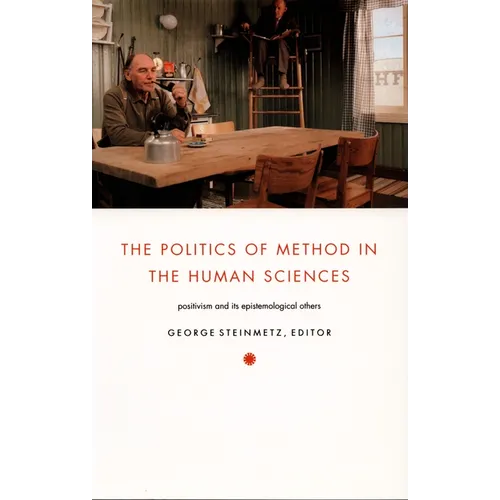
The Politics of Method in the Human Sciences provides a remarkable comparative assessment of the variations of positivism and alternative epistemologies in the contemporary human sciences. Often declared obsolete, positivism is alive and well in a number of the fields; in others, its influence is significantly diminished. The essays in this collection investigate its mutations in form and degree across the social science disciplines. Looking at methodological assumptions field by field, individual essays address anthropology, area studies, economics, history, the philosophy of science, political science and political theory, and sociology. Essayists trace disciplinary developments through the long twentieth century, focusing on the decades since World War II.
Contributors explore and contrast some of the major alternatives to positivist epistemologies, including Marxism, psychoanalysis, poststructuralism, narrative theory, and actor-network theory. Almost all the essays are written by well-known practitioners of the fields discussed. Some essayists approach positivism and anti-positivism via close readings of texts influential in their respective disciplines. Some engage in ethnographies of the present-day human sciences; others are more historical in method. All of them critique contemporary social scientific practice. Together, they trace a trajectory of thought and method running from the past through the present and pointing toward possible futures.
Contributors. Andrew Abbott, Daniel Breslau, Michael Burawoy, Andrew Collier, Michael Dutton, Geoff Eley, Anthony Elliott, Stephen Engelmann, Sandra Harding, Emily Hauptmann, Webb Keane, Tony Lawson, Sophia Mihic, Philip Mirowski, Timothy Mitchell, William H. Sewell Jr., Margaret R. Somers, George Steinmetz, Elizabeth Wingrove
Back Jacket
By contrasting the diverse trajectories and strategies of positivist method within each discipline, The Politics of Method in the Human Sciences "develops a comparative perspective which has been lacking in virtually all prior treatments of positivism in social science. The contrasts in the form and prestige that positivist method assumed in each discipline are striking."--Craig Calhoun, President of the Social Science Research Council
Author Biography
George Steinmetz is Professor of Sociology and German Studies at the University of Michigan. He is the author of Regulating the Social: The Welfare State and Local Politics in Imperial Germany and The Devil's Handwriting: Ethnographic Discourse and "Native Policy" in the German Overseas Empire (Southwest Africa, Samoa, and Quingdao/China) (forthcoming) and the editor of State/Culture: State-Formation after the Cultural Turn.



