Skip to content
Welcome To Our Store.
100,000+ Products for Home, Medical, Office & Classroom Needs
Search
Skip to product information
1 of 1

The Politics of Fashion in Eighteenth-Century America - Paperback

$64.73 USD
$64.73 USD
Sale Sold out
Shipping calculated at checkout.
In stock (100 units), ready to be shipped

Available Offers

Fastest Delivery Tomorrow With Vip DealOrder within 1 hr 8 mins.

Instant 10% Discount On HDFC Banks Credit/Debit Cards EMI and CreditCard

Secure checkout with
  • American Express
  • Apple Pay
  • Diners Club
  • Discover
  • Google Pay
  • Mastercard
  • PayPal
  • Shop Pay
  • Visa

Flight Range: Up to 1,000 meters (3,280 feet)

Maximum Speed: 45 kilometers per hour (28 miles per hour)

For all orders exceeding a value of 100USD shipping is offered for free.

Returns will be accepted for up to 10 days of Customer’s receipt or tracking number on unworn items. You, as a Customer, are obliged to inform us via email before you return the item.

Otherwise, standard shipping charges apply. Check out our delivery Terms & Conditions for more details.

View Product Details
Shopping cart
Product Product subtotal Quantity Price Product subtotal
The Politics of Fashion in Eighteenth-Century America - Paperback
$64.73/ea
$0.00
$64.73/ea $0.00

Product Description

by Kate Haulman (Author)

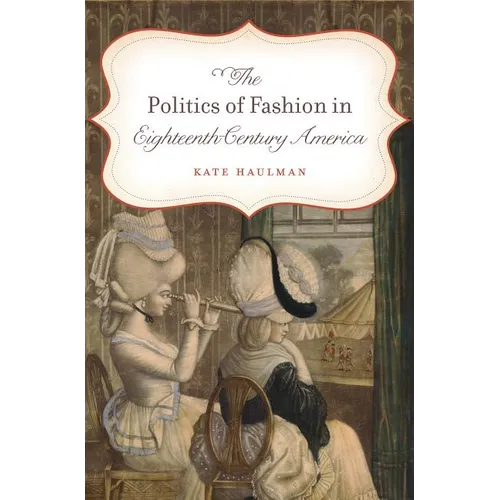
In eighteenth-century America, fashion served as a site of contests over various forms of gendered power. Here, Kate Haulman explores how and why fashion -- both as a concept and as the changing style of personal adornment -- linked gender relations, social order, commerce, and political authority during a time when traditional hierarchies were in flux.

In the see-and-be-seen port cities of Boston, New York, Philadelphia, and Charleston, fashion, a form of power and distinction, was conceptually feminized yet pursued by both men and women across class ranks. Haulman shows that elite men and women in these cities relied on fashion to present their status but also attempted to undercut its ability to do so for others. Disdain for others' fashionability was a means of safeguarding social position in cities where the modes of dress were particularly fluid and a way to maintain gender hierarchy in a world in which women's power as consumers was expanding. Concerns over gendered power expressed through fashion in dress, Haulman reveals, shaped the revolutionary-era struggles of the 1760s and 1770s, influenced national political debates, and helped to secure the exclusions of the new political order.


Number of Pages: 304
Dimensions: 0.69 x 9.21 x 6.14 IN
Illustrated: Yes
Publication Date: August 01, 2014
you might like
