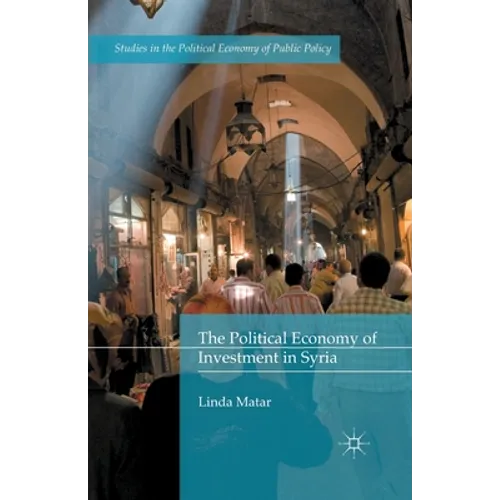
Product Description
by Linda Matar (Author)
Linda Matar examines Syria's failure to promote employment-generating investment prior to the uprising. Tackling the thorny issue of the inapplicability of modern investment theory to a developing country, she situates the analysis of investment in Syria in its historical context and examines the socioeconomic structure and political preconditions that set the course of capital accumulation. Matar argues that the class in charge of development, which oversaw the allocation of resources during the Hafiz and Bashar Assad regimes, precipitated a crisis of capital accumulation. Difficult-to-access data and information compiled from fieldwork reveal how neoliberal reforms failed to build productive capacity and instead enriched a few through short-term speculative and mercantile ventures. Productive investment in Syria prior to the uprising lurched downward, and the key related socio-economic variables followed. These deteriorating conditions contributed to the social explosion in 2011. Exploring the poor quality and quantity of investment, this study probes how the cant of the free market served as a veneer behind which the institutional decisions distorted income distribution in a way that would inevitably lead to collapse.
Back Jacket
Linda Matar examines Syria's failure to promote employment-generating investment prior to the uprising. Tackling the thorny issue of the inapplicability of modern investment theory to a developing country, she situates the analysis of investment in Syria in its historical context and examines the socioeconomic structure and political preconditions that set the course of capital accumulation. Matar argues that the class in charge of development, which oversaw the allocation of resources during the Hafiz and Bashar Assad regimes, precipitated a crisis of capital accumulation. Difficult-to-access data and information compiled from fieldwork reveal how neoliberal reforms failed to build productive capacity and instead enriched a few through short-term speculative and mercantile ventures. Productive investment in Syria prior to the uprising lurched downward, and the key related socio-economic variables followed. These deteriorating conditions contributed to the social explosion in 2011.Exploring the poor quality and quantity of investment, this study probes how the cant of the free market served as a veneer behind which the institutional decisions distorted income distribution in a way that would inevitably lead to collapse.
Author Biography
Linda Matar is Research Fellow at The National University of Singapore. Her research involves the political economy of the Arab Near East with particular emphasis on Syria. Her recent publications include the article 'Twilight of 'state capitalism' in formerly 'socialist' Arab states' (The Journal of North African Studies, 2013).