


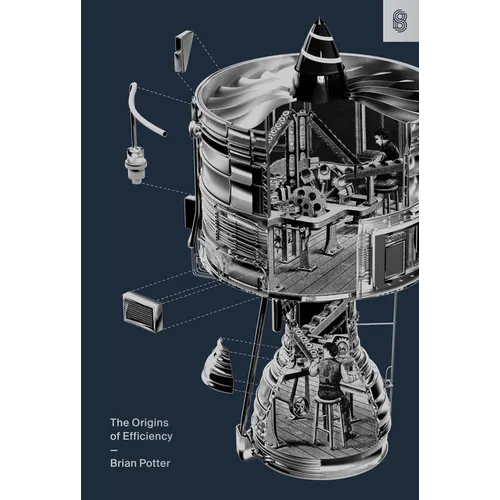
Product Description
by Brian Potter (Author)
An examination of how production processes--from penicillin to steel to semiconductors--get more efficient over time, and a powerful argument for efficiency as an underrated driver of progress.
Efficiency is the engine that powers human civilization. It's the reason rates of famine have fallen precipitously, literacy has risen, and humans are living longer, healthier lives compared to preindustrial times. But where do improvements in production efficiency come from? In The Origins of Efficiency, Brian Potter argues that improving production efficiency--finding ways to produce goods and services in less time, with less labor, using fewer resources--is the force behind some of the biggest and most consequential changes in human history. With unprecedented depth and detail, Potter examines the fundamental characteristics of a production process and how it can be made less time- and resource-intensive, and therefore less expensive. The book is punctuated with examples of production efficiency in practice, including how high-yield manufacturing methods made penicillin the "miracle drug" that reduced battlefield infection deaths by 80 percent during World War II; the 100-year history of process improvements in incandescent light bulb production; and how automakers like Ford, Toyota, and Tesla developed innovative production methods that transformed not just the automotive industry but manufacturing as a whole. He concludes by looking at sectors where production costs haven't fallen, and explores how we might harness the mechanisms of production efficiency to change that. The Origins of Efficiency is a comprehensive companion for anyone seeking to understand how we arrived at this age of relative abundance--and how we can push efficiency improvements further into domains like housing, medicine, and education, where much work is left to be done. "Brian Potter is the single best writer in America on how important things get built, and his new book is the single best example of his work." --Derek Thompson, author of Hit Makers and coauthor of Abundance"By the time you finish this book, you'll feel like you're well on your way to becoming an expert in manufacturing." --Noah Smith, author of Noahpinion
Author Biography
Brian Potter is the author of the Construction Physics newsletter and a senior infrastructure fellow at the Institute for Progress. He writes about the technology and economics of building construction, with a focus on improving productivity and reducing costs. He previously managed an engineering team at Katerra, a SoftBank-backed construction startup, and has 15 years of experience as a structural engineer. He holds a bachelor's in civil engineering from Georgia Tech and a master's in systems engineering from the University of Central Florida.