Product Description
by Martin E. Turkis II (Author)
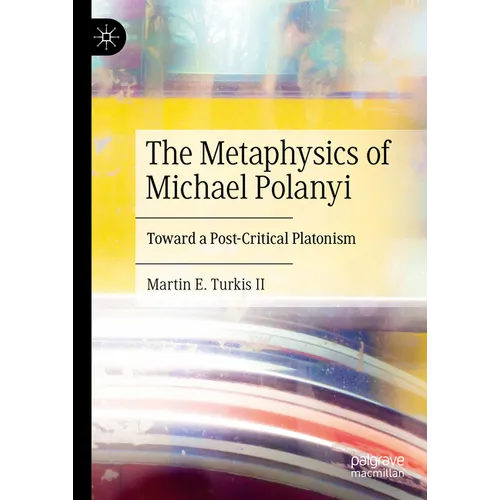
This book tells the story of how the Platonic vision of Michael Polanyi - the Hungarian-British chemist and philosopher - bridges the gap between speculative metaphysics and scientific practice, thus making sense of the broad swathe of human experience in a phenomenologically satisfying fashion. The central proposal is that Polanyi is a Platonist due to his affirmation of the ontological status of abstract objects, with particular focus placed on the question of uninstantiated universals. The book engages contemporary, speculative realists from both continental and analytic traditions as it introduces Polanyi's influential epistemology and unpacks the fascinating metaphysics implied thereby. It then proceeds to develop Polanyi's rather unsystematic metaphysics into a coherent, post-critical Platonism which incorporates his well-known theory of tacit knowledge, thus achieving something akin to the ancient Neoplatonic synthesis of Plato and Aristotle in our contemporary, scientific context.
Back Jacket
A provocative interpretation of such Polanyian ideas as fields, ordering principles, and comprehensive entities which re-energize Plato's notion of the Forms.--Walter Gulick, Professor Emeritus of Philosophy, Humanities and Religious Studies, Montana State University Billings
"Some of the most intellectually exciting work in Polanyi studies. It promises to have an important impact beyond most all that has gone before. It makes plain how Polanyi fits into the history of metaphysics and it enables us to see beyond Polanyi's own shortcomings and lacunae qua philosopher, resolving many of the long-standing controversies among Polanyi scholars."--Dale Cannon, Professor Emeritus of Philosophy & Religious Studies, Western Oregon University
This book tells the story of how the Platonic vision of Michael Polanyi - the Hungarian-British chemist and philosopher - bridges the gap between speculative metaphysics and scientific practice, thus making sense of the broad swathe of human experience in a phenomenologically satisfying fashion. The central proposal is that Polanyi is a Platonist due to his affirmation of the ontological status of abstract objects, with particular focus placed on the question of uninstantiated universals. The book engages contemporary, speculative realists from both continental and analytic traditions as it introduces Polanyi's influential epistemology and unpacks the fascinating metaphysics implied thereby. It then proceeds to develop Polanyi's rather unsystematic metaphysics into a coherent, post-critical Platonism which incorporates his well-known theory of tacit knowledge, thus achieving something akin to the ancient Neoplatonic synthesis of Plato and Aristotle in our contemporary, scientific context.
Martin E. Turkis II is a philosopher, teacher, and musician residing in San Francisco. He holds a Ph.D. in philosophy with honors from the University of Navarra. His interests include political economy, virtue ethics, and philosophy of education. He is an associate editor of the journal Tradition and Discovery.
Author Biography
Martin E. Turkis II is a philosopher, teacher, and musician residing in San Francisco. He holds a Ph.D. in philosophy with honors from the University of Navarra. His interests include political economy, virtue ethics, and philosophy of education. He is an associate editor of the journal Tradition and Discovery.