Product Description
by Elise Wang (Author)
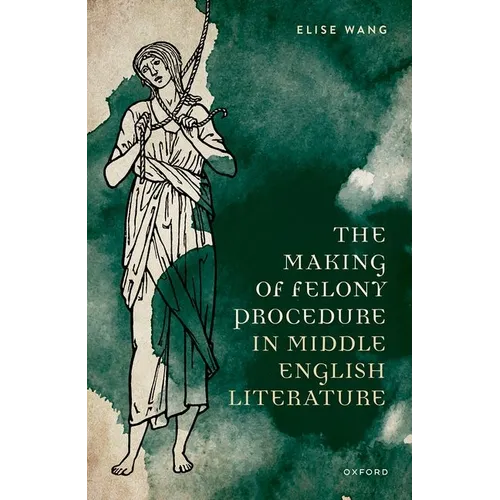
The Making of Felony Procedure in Middle English Literature explores the literary inheritance of criminal procedure in thirteenth to fifteenth century English law, focusing on felony, the gravest common law offense. Most scholarship in medieval law and literature has focused on statute and theory, drawing from the instantiating texts of English law: acts of Parliament, judicial treatises, the Magna Carta. But those whose job it was to write about the law rarely wrote about felony. Its definition was left to its practice--from investigation to conviction--and that procedure fell to local communities who were generally untrained in the law. Left with many practical and ethical questions and few legal answers, they turned to cultural ones, archived in sermons they had heard, plays they had seen, and poetry they knew. This book reads the documents of criminal procedure--coroners' reports, plea rolls, and gaol delivery records--alongside literary scenes of investigation, interrogation, and witnessing to tell a new intellectual history of criminal procedure's beginnings.
The chapters of The Making of Felony Procedure guide the reader through the steps of a felony prosecution, from act to conviction, examining the questions local communities faced at each step. What evidence should be prioritized in a death investigation? Should the accused consider narrative satisfaction when building his plea? What are the dangers of a witnessing system that depends so heavily on a few "oathworthy" men? What can a jury do if the accused's guilt seems partial or complex? And what if the defendant-for whatever reason--refuses to participate in this new, still--delicate system of justice? The book argues that answers they found, and the sources that informed them, created the system that became modern criminal procedure. The epilogue offers some thoughts about the resilience and incoherence of the concept of felony, from the start of the jury trial to the present day.Author Biography
Elise Wang, Assistant Professor of English, California State University, Fullerton
Elise Wang (A.B. Harvard University, M.St. Oxford University, Ph.D. Princeton University) is an assistant professor of medieval literature at California State University, Fullerton. Before joining the faculty there, she taught for two years in a postdoctoral position at Duke University and for six years as a cofounder of a prison teaching program at Garden State Correctional Facility. She has been the recipient of the Charlotte Newcombe Doctoral Fellowship, University Center for Human Values Graduate Prize Fellowship, and a Rhodes Scholarship (Illinois & Merton). Her work has appeared in New Medieval Literatures, Exemplaria, Modern Language Review, TED, and The Daily Show Podcast.