


Product Description
by Jeffrey Chapman (Author)
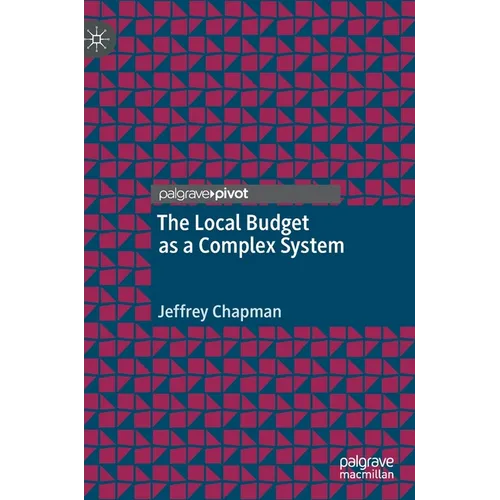
This book examines budgeting by analyzing the local government budget as a complex system, thus adding a new dimension to traditional budget textbooks. It is designed to complement existing texts--not replace--by putting the budget in a complex system, general equilibrium framework. A complex systems framework adds to conventional budget analysis in at least four ways: It looks at the budget as the result of many variables that are outside the finance department's purview; it understands that there are multiple interdependences among these variables; it suggests analysis of non-obvious relationships among actions in the budget process in order to optimize results; and it argues that the actors in the process must understand that their budgetary behaviors have indirect and far-reaching implications that go beyond the budget document.
This book also uses concepts seldom discussed in the budgetary literature--that of governance, including concepts of the facilitative state, with adjustments for exogenous shocks; the forms of decision making; and the political climate of the jurisdiction. This framework notes methods of success of firms in the private sector that operate in environments of rapid technological change. While becoming a popular theoretical framework for how private sector firms change, dynamic capability analysis has received little attention in the public management field. This book utilizes DC since public sector organizations also face rapidly changing environments. Lastly, the book discusses the potential relationship between the local budget and local community welfare maximization.
Back Jacket
"In this book, Jeffrey Chapman characterizes public resource allocation as a complex and interdependent system both consequent and antecedent to economic and political forces. Budgeting is considered here beyond the basic allocation of public resources to particular things, but as a fundamental lever of fiscal sustainability. Chapman provides many important insights and caveats. His framework for thinking about economic development, for example, moves beyond goals and strategies and demonstrates how large and long-term infrastructure investments can trade off against the very fiscal sustainability that economic development concerns itself with. This is a nuanced and informative work that deserves space on the shelf of both professionals and scholars."
--Mark Robbins, Professor of Public Policy, University of Connecticut
"In The Local Budget as a Complex System, Dr. Chapman provides a long overdue and much-needed perspective on public budgeting. His description and analysis of public budgeting as a complex system of dynamic relationships and interdependencies will be singularly useful in advancing the discussion on how public budgeting is understood in local governments across the nation and taught in public administration and public policy programs."
--Craig Johnson, Associate Professor at the School of Public and Environmental Affairs, Indiana University
This book examines budgeting by analyzing the local government budget as a complex system, thus adding a new dimension to traditional budget textbooks. It is designed to complement existing texts--not replace--by putting the budget in a complex system, general equilibrium framework. A complex systems framework adds to conventional budget analysis in at least four ways: It looks at the budget as the result of many variables that are outside the finance department's purview; it understands that there are multiple interdependences among these variables; it suggests analysis ofnon-obvious relationships among actions in the budget process in order to optimize results; and it argues that the actors in the process must understand that their budgetary behaviors have indirect and far-reaching implications that go beyond the budget document.
Jeffrey Chapman joined the ASU faculty in 1999 as the Director of the School of Public Affairs after 26 years at the University of Southern California. After four years as Director, he was appointed as Interim Dean of the College of Public Programs. Chapman retired as an Emeritus Foundation Professor of Applied Public Finance in 2013. He is a member of the Arizona Economic Round Table and is on the Board of Directors of the Grand Canyon Institute. In 2017, the Association of Budgeting and Financial Management awarded him the Aaron Wildavsky lifetime achievement award for public budgeting and finance.
Author Biography
Jeffrey Chapman joined the ASU faculty in 1999 as the Director of the School of Public Affairs after 26 years at the University of Southern California. After four years as Director, he was appointed as Interim Dean of the College of Public Programs. Chapman retired as an Emeritus Foundation Professor of Applied Public Finance in 2013. He is a member of the Arizona Economic Round Table and is on the Board of Directors of the Grand Canyon Institute. In 2017, the Association of Budgeting and Financial Management awarded him the Aaron Wildavsky lifetime achievement award for public budgeting and finance.